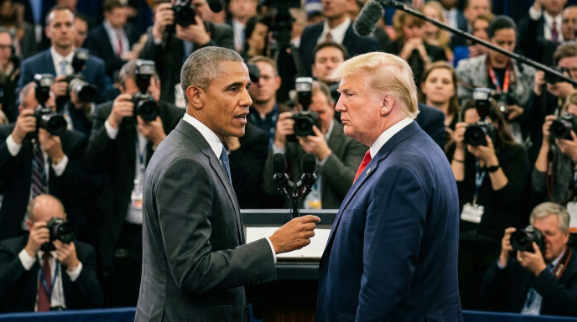
Americans continue to debate the economic records of President Donald Trump and former President Barack Obama, with supporters of each administration pointing to different measures of growth, employment, energy production and household prosperity.
Trump’s supporters highlight tax cuts, deregulation, domestic energy production and manufacturing, while Obama’s supporters point to the recovery from the Great Recession, sustained job creation and declining unemployment during his two terms.
Comparing the two records, however, is more complicated than simply assigning credit to one president. Economic conditions are influenced by global events, Federal Reserve policy, Congress, consumer behavior and trends that often continue across presidential administrations.
The Economy Obama Inherited
When Obama entered office in January 2009, the United States was in the middle of the Great Recession.
Unemployment was 7.8% when he took office and reached 10% later that year. The economy contracted sharply during 2009 before beginning a prolonged recovery.
By the time Obama left office in January 2017, unemployment had fallen to 4.7%.
FactCheck.org notes that total nonfarm employment increased by more than 11.6 million during Obama’s eight years, although much of the early period was spent recovering from the severe job losses associated with the financial crisis. Real GDP declined in 2009 but expanded in every subsequent year of his presidency.
Obama’s administration also oversaw the implementation of major financial and regulatory reforms following the financial crisis, including the Dodd-Frank Act and the Affordable Care Act.
Critics, however, argued that the recovery was too slow and that regulatory policies placed additional burdens on businesses.
Trump’s First-Term Economy
Trump entered office in 2017 after the recovery was already well underway.
During the three years before the COVID-19 pandemic, the economy continued to expand, unemployment fell to historically low levels and wages increased.
The unemployment rate reached 3.5% in late 2019, its lowest level in roughly half a century at the time.
Trump’s administration also enacted the Tax Cuts and Jobs Act of 2017, which reduced corporate and individual tax rates. Supporters argued that lower taxes would encourage investment, hiring and economic growth.
The administration also pursued deregulation and promoted increased domestic oil and natural-gas production.
But economists caution against attributing every improvement during those years directly to presidential policies.
PolitiFact found that many of the positive economic trends during Trump’s first term had already begun during Obama’s final years. The unemployment rate, for example, had been declining steadily since 2011.
Manufacturing and Energy
Manufacturing and energy have become major parts of the political argument.
Trump has repeatedly emphasized his efforts to bring manufacturing jobs back to the United States and expand domestic energy production.
Supporters point to tariffs, incentives and deregulation as tools intended to strengthen American industry and reduce dependence on foreign supply chains.
However, the record is mixed. Manufacturing employment was already recovering before Trump took office, and the COVID-19 pandemic caused severe disruption during his first term.
Energy production also increased substantially during the broader period, although technological developments such as hydraulic fracturing and horizontal drilling had transformed the U.S. energy industry before either Trump or Obama took office.
That makes it difficult to assign the entire increase in domestic energy production to any single administration.
The COVID-19 Factor
Any comparison of Trump’s first term must account for the pandemic.
The U.S. economy experienced an unprecedented contraction in 2020 as businesses closed and millions of Americans lost their jobs.
FactCheck.org reports that total employment fell by 2.7 million over Trump’s full four-year term, while the unemployment rate ended at 6.4%. At the same time, inflation-adjusted weekly earnings increased and the stock market reached record levels by the end of his term.
Because the pandemic dramatically distorted economic data, comparing Trump’s full first term directly with Obama’s eight years can produce misleading conclusions.
What About Trump’s Second Term?
Trump’s current economic record is a separate question.
By July 2026, FactCheck.org reported that employment had increased by about 716,000 since January 2025, while the unemployment rate stood at 4.2%. Inflation had risen to 3.5% in June, and manufacturing employment had continued to decline despite the administration’s tariff policies.
Reuters similarly reported that Trump’s second term had produced mixed economic results, with tariffs, immigration restrictions and higher energy costs contributing to economic uncertainty. The report noted that manufacturing jobs had declined while housing affordability had deteriorated.
The Trump administration disputes this characterization.
The Treasury Department said in August that business investment rose at an annualized rate of nearly 10% during the first half of 2026 and described the economy as resilient, while noting that wage growth continued to outpace inflation.
The conflicting assessments demonstrate why economic comparisons remain politically contentious.
What Economists Say About Presidential Credit
One of the most important points in comparing presidents is that economic results rarely begin or end on Inauguration Day.
Policies can take years to affect investment, employment and household incomes. Businesses and consumers also make decisions based on conditions that have little to do with the White House.
The Washington Post’s analysis of the Trump and Obama economies similarly cautioned against giving presidents sole credit for economic changes, noting that employment growth under Trump continued a trend that had begun during Obama’s presidency.
This does not mean presidential policies have no effect. Tax legislation, trade policy, regulation, energy policy and government spending can influence the economy.
The challenge is determining how much of the observed outcome can reasonably be attributed to those policies.
Which Record Was Better for Working Families?
The answer depends partly on which economic measures voters consider most important.
Those prioritizing low unemployment, rising wages and domestic energy production may point to different periods of the Trump presidency.
Those emphasizing the long recovery from the Great Recession, sustained job creation and falling unemployment may view Obama’s record more favorably.
Tax policy also divides the two approaches. Trump’s 2017 tax cuts emphasized lower tax rates and business investment, while Obama’s administration pursued a different balance between taxation, regulation and government spending.
Neither record provides a simple story of uninterrupted success or failure.
For working-class households, the most meaningful measures may ultimately be practical ones: Are wages rising faster than prices? Is housing affordable? Are stable jobs available? Can families afford energy and transportation? And is economic growth broad enough to improve living standards?
Those questions offer a more useful way to evaluate presidential economic policy than political slogans alone.
As voters compare the records of Trump and Obama, the central question is not simply which president can claim the strongest headline numbers. It is which combination of policies produced the most sustainable improvement in the financial security of ordinary American households.