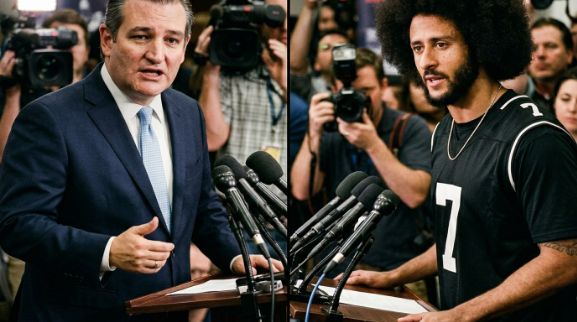
Sen. Ted Cruz is using Nike’s prolonged stock decline to renew a broader debate over whether corporations risk damaging their brands when they become involved in politically divisive cultural issues.
Cruz, a Republican from Texas, recently criticized Nike after the athletic company’s shares fell to their lowest level in roughly 12 years. Nike’s stock has declined dramatically from its 2021 peak, losing close to 80% of its value from that high.
Cruz argued that Nike’s marketing decisions alienated some longtime customers, pointing specifically to the company’s decision in 2019 to withdraw a shoe featuring the Betsy Ross flag after concerns were raised about the design.
But whether political controversy caused Nike’s financial struggles is a much more complicated question.
Cruz Connects Nike’s Decline to Brand Politics
Cruz said on social media that he had worn Nike products for most of his life before the company’s political and cultural controversies changed his view of the brand.
He specifically cited Nike’s relationship with former NFL quarterback Colin Kaepernick and the company’s decision to cancel the Betsy Ross-themed shoe as turning points.
Cruz argued that these decisions demonstrated a marketing strategy he believed was increasingly disconnected from some American consumers. He also described his own decision to stop buying Nike products as evidence that other customers may have done the same.
His argument reflects a broader conservative criticism of what is sometimes called “corporate activism” — the practice of companies taking public positions on political, social or cultural issues.
The underlying question is whether such positions strengthen customer loyalty or instead push away consumers who disagree with them.
Nike’s Stock Has Fallen Sharply
There is no question that Nike’s stock has experienced a major decline.
Shares reached an all-time high of about $177.51 in 2021. By August 2026, the stock had fallen below $40, with reports estimating that the company had lost nearly $200 billion in market value from its peak.
That decline has provided ammunition for critics who argue that Nike’s cultural and political positioning hurt the company’s relationship with customers.
But the timing matters.
Nike’s decline has occurred over several years and has coincided with a range of business challenges. The company’s difficulties cannot automatically be attributed to political controversies or consumer boycotts.
Analysts Point to Broader Business Problems
Nike has faced challenges involving sales growth, competition, inventory management and its relationship with consumers.
The company’s stock performance has therefore become part of a much larger discussion about whether its strategy has successfully adapted to a changing athletic-apparel market.
That makes it difficult to establish a direct cause-and-effect relationship between Nike’s political controversies and its stock price.
A falling stock price tells investors that the market has become less optimistic about a company’s future value, but it does not explain exactly why investors are selling.
Multiple factors can influence a stock simultaneously, including earnings expectations, competition, consumer demand, management decisions and broader economic conditions.
The Debate Goes Beyond Nike
Nike is not the only company to face controversy after taking positions on social or political issues.
The 2023 Bud Light controversy became another major example. Anheuser-Busch faced a consumer backlash following its partnership with transgender influencer Dylan Mulvaney, and Bud Light subsequently experienced a major decline in U.S. sales.
Cruz became involved in that controversy as well, launching a Senate inquiry into the company’s marketing practices.
Recent reporting shows that Bud Light’s problems have continued well beyond the initial controversy, with the brand struggling to regain its previous position in the U.S. beer market.
These cases have fueled arguments from conservatives that corporations should concentrate on their products rather than entering politically sensitive cultural debates.
Can Corporate Activism Help a Brand?
The opposing argument is that companies do not necessarily lose customers when they take political or social positions.
Some businesses believe public values can strengthen connections with particular groups of consumers and employees.
Corporate executives may also view issues such as climate change, diversity, human rights or political participation as matters that affect their workforce, customers or long-term business interests.
The challenge is that a company’s customer base may not share the same political beliefs.
A position that creates strong loyalty among one group can potentially generate opposition from another.
For investors, the critical question is whether the overall effect helps or hurts the company’s long-term financial performance.
Does Political Neutrality Protect Shareholders?
There is no simple rule showing that politically neutral companies consistently outperform companies that take public positions.
Stock prices respond to many variables, and a company’s political messaging is only one potential factor.
Nike’s current difficulties, for example, cannot be reduced to one advertising campaign or one cultural controversy. The company’s long-term performance reflects a combination of brand strategy, competition, consumer demand and financial expectations.
Still, Cruz’s argument highlights a genuine business risk: companies can misjudge their customers just as politicians can misjudge voters.
When a major brand takes a controversial position, consumers have the ability to respond through their purchasing decisions, while shareholders can respond through the market.
The Consumer Is Still Central
The debate ultimately returns to a fundamental question about the relationship between business and politics.
Should corporations actively participate in cultural and political debates, even when doing so risks alienating part of their customer base?
Or should companies concentrate primarily on their products, prices, quality and customer service while leaving political questions to elected officials and individual citizens?
Supporters of corporate activism argue that businesses are part of society and should be able to express their values.
Critics counter that corporations have a responsibility to customers and shareholders first and should be cautious about turning brands into political symbols.
Nike’s long-term stock decline does not prove that political activism caused the company’s problems. But it has given critics a powerful example for their argument that brand loyalty can be fragile when consumers feel a company no longer represents them.
For businesses, the challenge may not be whether they should ever take a political position, but whether they fully understand the financial and reputational consequences before doing so.
Should major corporations remain politically neutral to protect their brands and shareholder value, or should companies be free to take public positions on issues that matter to them and their customers?