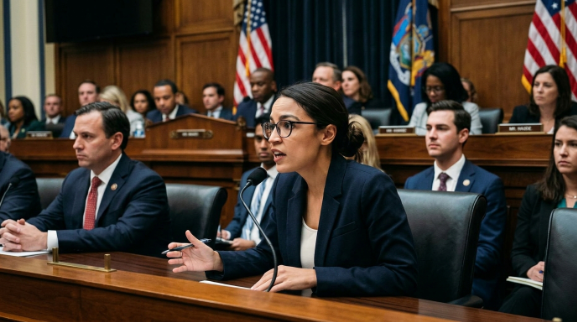
Representative Alexandria Ocasio-Cortez is increasingly being discussed as a potential contender for the Democratic presidential nomination in 2028, putting her progressive economic and environmental agenda under renewed scrutiny.
Ocasio-Cortez has not announced a presidential campaign. When asked in May about a possible 2028 run, she said her ambition was to “change the country” rather than directly confirming whether she would seek higher office. More recently, she has said she has not ruled out either a presidential campaign or a challenge for New York’s U.S. Senate seat.
Her possible candidacy is attracting attention because of the contrast between her progressive policy agenda and the more moderate approaches favored by some Democrats.
A Progressive Economic Vision
Ocasio-Cortez has built her political identity around economic populism, climate policy, affordable housing and expanded government investment.
Her platform has included major investments in public housing and proposals aimed at transitioning public housing toward zero-carbon, energy-efficient buildings. Her campaign website says she has called for $70 billion to repair the nation’s public housing system, along with additional funding to address lead contamination.
She has also continued to support versions of the Green New Deal. Her approach emphasizes renewable energy, emissions reductions, public investment and the creation of what she describes as well-paying jobs in a clean-energy economy.
Supporters argue that these policies could address several problems at once: climate change, housing costs, aging infrastructure and income inequality.
The argument is that government investment today could reduce long-term costs while creating new industries and employment opportunities.
Critics Question the Cost
Critics take a different view.
They argue that aggressive efforts to move away from fossil fuels could increase energy costs if reliable alternatives are not available quickly enough. They also question whether large government spending programs and stricter regulations would ultimately make housing, transportation and everyday goods more affordable.
These concerns are especially relevant to working-class households, for whom gasoline, electricity, rent and home prices represent significant portions of monthly budgets.
However, it is important to distinguish between criticism of a policy and evidence that the policy will produce a specific economic outcome. Whether a particular climate or housing measure raises or lowers household costs depends on its design, implementation, energy prices and broader economic conditions.
Energy Is a Central Part of the Debate
Energy policy is one of the clearest dividing lines.
Ocasio-Cortez’s Green New Deal proposal has historically called for a rapid transition toward renewable energy and a major reduction in greenhouse-gas emissions. Her supporters argue that expanding clean energy could reduce dependence on fossil fuels, create domestic industries and protect households from some long-term environmental and economic risks.
Critics worry about the speed and cost of such a transition.
They argue that the United States still relies heavily on oil and natural gas and that moving too quickly could put pressure on energy prices unless new generation, transmission and storage capacity are developed at the same time.
The debate therefore is not simply about whether the country should develop cleaner energy. It is also about how quickly the transition should happen and who should bear the costs.
Housing Is Another Major Issue
Housing affordability has also become an important part of the progressive economic agenda.
Ocasio-Cortez has supported significant federal investment in public housing and legislation designed to improve the condition and energy efficiency of existing housing stock. A Green New Deal for Public Housing proposal she introduced with Sen. Bernie Sanders sought major federal investment in public housing while reducing energy consumption and creating jobs.
The broader progressive argument is that government can help lower housing costs by increasing supply, improving public housing and providing assistance to households struggling with high rents and home prices.
But critics question the scale of government spending and regulation involved, arguing that housing affordability also requires more construction, faster permitting and policies that encourage private development.
What Analysts See in a Potential 2028 Campaign
Political analysts increasingly view Ocasio-Cortez as one of the more prominent figures in the emerging 2028 Democratic field.
Reuters reported in July that Democrats were already beginning to position themselves for the 2028 presidential race, although there was no clear party frontrunner.
Recent analysis has also suggested that Ocasio-Cortez is attempting to broaden her appeal beyond the progressive base. Axios reported in August that she has been distancing herself from some of her earlier rhetoric on issues such as policing and immigration, a potential sign of political repositioning ahead of a possible national campaign.
That could become important if she ultimately seeks the presidency.
A national campaign would require Ocasio-Cortez to appeal not only to progressive voters in major cities but also to suburban, rural and working-class voters who may have different priorities on energy, immigration, taxes and government spending.
The Economic Question for Voters
The larger debate surrounding Ocasio-Cortez is therefore not simply whether Americans support progressive policies.
It is whether those policies can deliver lower costs, stronger wages, affordable housing and reliable energy while achieving their environmental and social goals.
Supporters believe substantial government investment and economic reform are necessary to address problems that they argue traditional policies have failed to solve.
Critics counter that large-scale government programs and rapid regulatory changes could increase costs and create unintended economic consequences.
Both arguments will likely receive greater attention if Ocasio-Cortez decides to seek the White House.
For now, she has not officially entered the 2028 presidential race. But her growing national profile ensures that her economic vision will remain part of the conversation about the future direction of the Democratic Party and the country.
The central question for voters may ultimately be simple: should America’s economic future emphasize faster government-led transformation, or a more gradual approach focused on affordability, energy reliability and proven economic growth?