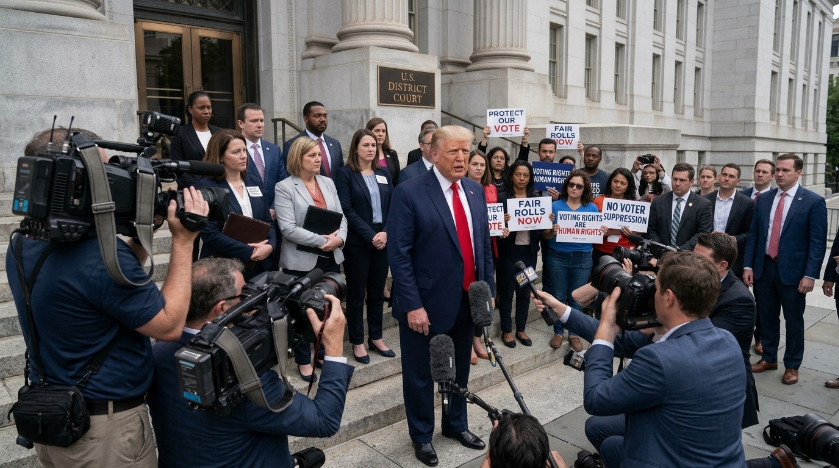
The Trump administration is facing another legal battle over access to state voter-registration information as the federal government continues its push to examine election records ahead of the 2026 midterm elections.
The latest dispute adds to a growing series of court fights involving the administration’s efforts to obtain detailed voter-roll data from states.
The Justice Department has argued that access to state election information is necessary to help ensure that voter-registration systems comply with federal law and that eligible voters are properly protected.
State officials and voting-rights organizations, however, have challenged some of those requests, arguing that the federal government is seeking information that states are not required to provide.
The disagreement has increasingly moved into federal court.
The administration’s broader election effort has focused on identifying problems in voter-registration databases, including potentially outdated or inaccurate records.
Federal officials have argued that examining voter rolls can help identify registration errors and strengthen election integrity.
Critics have countered that aggressive federal demands could interfere with states’ traditional responsibility for administering elections.
That distinction is particularly important in the United States because elections are largely administered by individual states and local governments rather than by a single national election authority.
The legal disputes therefore raise questions about how far the federal government can go when requesting information maintained by state election officials.
The controversy comes as the 2026 midterm elections approach, increasing the political significance of the dispute.
Control of Congress will be at stake in November, meaning election administration and voter-registration procedures are likely to remain major political issues throughout the campaign season.
Republicans have continued to emphasize election security and accurate voter rolls, while Democrats and voting-rights advocates have warned that aggressive investigations could create unnecessary barriers for eligible voters.
The administration’s efforts have already produced mixed results in the courts.
Some legal challenges have limited what federal officials can obtain from states, while other cases have allowed portions of the administration’s election-related initiatives to move forward.
The latest court fight is therefore part of a much larger legal battle over federal election authority.
For Trump, the issue is also tied to one of his administration’s central political arguments: that election systems should be subject to greater scrutiny to prevent fraud and protect public confidence.
His opponents argue that election fraud has been repeatedly overstated and that aggressive federal intervention could undermine confidence rather than strengthen it.
The disagreement is unlikely to disappear before the midterms.
As additional states respond to federal requests and more lawsuits move through the courts, judges could ultimately be asked to determine the limits of the administration’s authority to obtain and use state election information.
The outcome could have implications beyond the current dispute.
A ruling establishing broader federal access to state voter data could give the administration greater ability to investigate voter-registration systems across the country.
A decision favoring the states, meanwhile, could place stronger limits on Washington’s ability to demand election information from state governments.
With the 2026 elections approaching, the legal battle over voter rolls is becoming another important front in the broader fight over election administration.
The immediate question is whether the Trump administration can overcome the latest legal resistance—or whether the courts will continue placing limits on its effort to reshape how federal officials oversee election information.