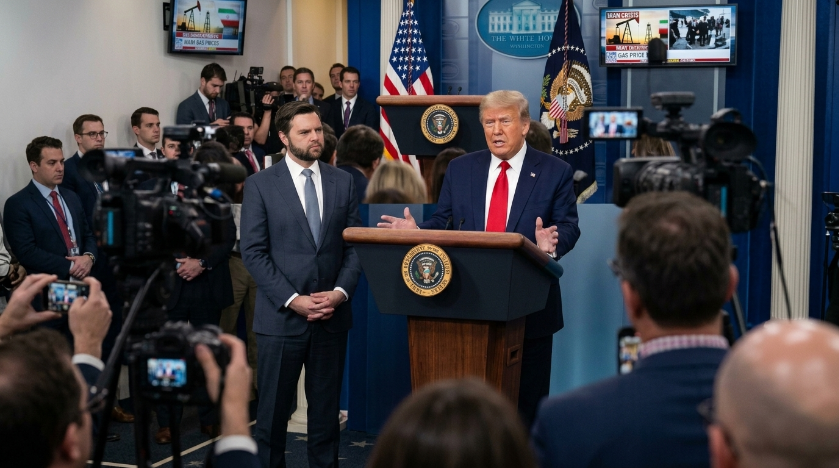
WASHINGTON — August 14, 2026 — Rising gasoline prices are becoming one of the most visible economic consequences of the continuing U.S.-Iran conflict, putting additional pressure on American households and creating a growing political challenge for President Donald Trump.
The national average price of gasoline has climbed above $4 per gallon, according to recent reporting, marking a level that is especially significant for American consumers.
The increase comes as disruptions around the Strait of Hormuz continue to affect global energy markets.
Trump Administration Makes Gas Prices a Priority
The White House is increasingly focusing on the impact of energy prices on American consumers.
Vice President JD Vance said keeping oil and gasoline prices affordable for Americans is now the administration’s top priority in the Iran conflict, ahead of preventing Iran from obtaining a nuclear weapon.
The statement highlights how seriously Washington is taking the economic impact of the conflict.
For American drivers, the issue is straightforward: higher gasoline prices mean more expensive trips to work, school, stores and vacations.
Strait of Hormuz Remains at the Center
The Strait of Hormuz is one of the world’s most important energy corridors.
Around 20% of global oil and LNG shipments normally pass through the waterway, meaning disruptions can quickly affect international oil markets.
Shipping traffic has fallen sharply amid the conflict, while attacks on commercial vessels have added further uncertainty.
Reuters reported Friday that oil prices were rising after the United States threatened to maintain an indefinite naval blockade of Iran.
Oil Prices Are Moving Higher Again
Brent crude rose to around $88.50 per barrel, while U.S. West Texas Intermediate crude climbed to roughly $82.81 on Friday, according to Reuters.
Higher crude prices can eventually feed into gasoline prices, although the relationship is not immediate and other factors — including refinery capacity, inventories and seasonal demand — also influence what Americans pay at the pump.
Americans Are Feeling the Impact
For many households, gasoline is one of the most noticeable parts of the inflation problem.
Higher fuel costs can affect more than drivers. Transportation companies, airlines, delivery services and businesses that rely heavily on fuel can also face higher operating costs.
Those expenses can eventually be passed on to consumers through higher prices for goods and services.
That is why the gas-price issue could become increasingly important as the 2026 midterm elections approach.
Trump Faces a Difficult Balancing Act
The Trump administration is now attempting to maintain pressure on Iran while preventing the conflict from creating even greater economic damage at home.
Treasury Secretary Scott Bessent has warned of additional economic pressure on Tehran, while Defense Secretary Pete Hegseth has said the U.S. military has the ability to maintain the blockade indefinitely.
But a prolonged confrontation could continue putting pressure on oil markets.
That creates a difficult political calculation for the administration: pressure Iran without allowing energy costs to become an even bigger burden for American families.
Could Gas Prices Come Back Down?
There are reasons for both optimism and concern.
U.S. crude inventories recently recorded a major increase, which could help offset some of the pressure created by geopolitical tensions. Reuters also reported that weaker global demand could limit how far oil prices rise.
However, continued disruption around the Strait of Hormuz could keep markets nervous.
If shipping activity remains restricted or the conflict escalates, oil prices could face additional upward pressure.
What Happens Next?
The direction of gasoline prices will depend heavily on what happens between the United States and Iran.
A reopening or stabilization of the Strait of Hormuz could ease some of the pressure on global energy markets.
But continued attacks, blockades or further escalation could keep oil prices elevated and make the situation more difficult for American consumers.
For Trump, the challenge is becoming increasingly personal for millions of voters.
The question Americans are asking is no longer just what happens in Iran — it’s what happens the next time they pull into a gas station.