I remember the grocery bag hitting the floor.
I do not remember hitting it.
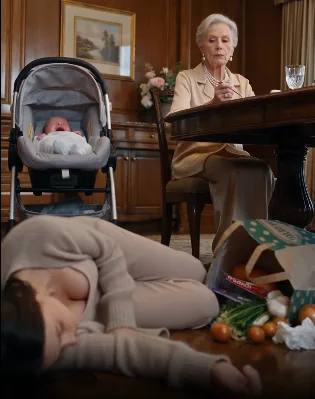
One second I was standing beside the dining table, holding the back of a chair because the room had begun to tilt.
The next, a carton of eggs burst beside my slippers.
A jar of pasta sauce rolled beneath the table.
Three apples bumped into one another and stopped against a chair leg.
Then the ceiling moved.
I remember thinking:
Theo.
Not:
I’m falling.
Not:
My head hurts.
Not:
Call someone.
Theo.
My son was three weeks old.
He was in the bassinet beside the sitting-room doorway, wrapped in a soft cream blanket, screaming with the furious desperation only newborns manage.
I had fed him less than an hour earlier.
He was probably hungry again.
Or wet.
Or overtired.
Or simply three weeks old.
I tried to turn toward him.
My legs disappeared.
I went down beside the table.
No graceful collapse.
No dramatic hand to forehead.
My shoulder struck the rug.
My cheek touched the hardwood.
My eyes stayed open for perhaps two seconds.
Then everything dimmed.
I heard Marcia’s voice as if she were speaking from the far end of a tunnel.
“Drama queen. Dinner still isn’t finished.”
That sentence reached me.
Not because I understood it.
Because I had heard versions of it for twenty-one days.
Three weeks.
Exactly as long as Theo had been alive.
Get up.
He just ate.
The laundry cannot fold itself.
You cannot nap every time the baby naps.
A house does not stop because a woman gives birth.
Real mothers learn.
Real wives manage.
Dinner at six.
Kitchen before bed.
I had spent three weeks believing maybe she was right.
That was the part I hated later.
Not Marcia.
Not Colin.
Me.
The small part of me that kept asking whether my body was recovering too slowly.
Whether every other mother somehow knew how to feed a newborn, wash bottles, change sheets, shop for groceries, cook dinner, answer family messages, wash pans, keep a bathroom clean, and stay awake through the night without once putting both hands on a kitchen counter and praying the dizziness passed.
Then I heard footsteps.
Fast.
A man’s shoes across the marble entry.
My father.
I did not know it was him at first.
I heard:
“Alessandra.”
Then his knees hit the floor beside me.
Giorgio Bellafonte did not kneel for many people.
At fifty-seven, he could make a room of senior executives stop whispering simply by taking off his glasses.
He wore black suits even in August.
A signet ring my grandfather gave him at twenty-five.
A watch he never removed.
Polished shoes.
A face people described as intimidating when they did not know what else to call a man who had spent thirty years learning not to reveal uncertainty.
But when he touched my face, his hand shook.
“Alessandra.”
I tried to answer.
My tongue felt thick.
Theo screamed again.
Dad looked toward the bassinet.
Then back at me.
“Can you hear me?”
I moved my head.
Barely.
“Did you hit your head?”
I did not know.
Marcia said from the table:
“She fainted because she refuses to eat properly.”
Dad looked at her.
I felt his body become still.
Then:
“Do not speak for her.”
He put one arm behind my shoulders.
“Alessandra, I’m going to sit you up.”
I tried.
My vision went black at the edges.
He supported almost all my weight until I was in the dining chair.
Then he crossed to Theo.
Picked him up carefully.
Head supported.
Blanket secure.
My father had not held a three-week-old baby in twenty-nine years before Theo was born.
He still moved as though Theo were glass.
He brought him to me.
Placed him against my chest while keeping one hand beneath the baby until my arms closed securely around him.
Theo stopped screaming almost immediately.
Not completely.
He made little wounded sounds against my nursing top.
I looked at Dad.
“Dad… she wouldn’t let me rest.”
The room changed.
Colin had been near the kitchen doorway.
My husband.
Thirty-six.
Dress shirt rolled at the forearms.
Wedding ring.
Watch.
Hair perfectly combed.
He finally stepped forward.
Not toward me.
Not toward Theo.
He pointed toward the kitchen.
There were pans in the sink.
A cutting board.
Unfinished vegetables.
A pot on the stove.
“Mom said Alessandra needed to learn her responsibilities.”
My father rose.
Slowly.
I knew that movement.
“Dad.”
Too late.
He slapped Colin.
Once.
Open hand.
Thunderous.
Colin’s head snapped sideways.
He stumbled backward into Marcia’s dining table.
Plates flew.
A water glass shattered.
His hip struck an empty chair and he collapsed into it.
Theo startled against me.
That sound cut through everything.
“Dad.”
This time Giorgio heard.
He stopped.
Colin held one hand against his cheek.
Marcia stood halfway.
“You animal.”
Dad looked at her.
Then at me.
The anger disappeared from his face.
Not because it was gone.
Because he put it somewhere else.
“Hospital.”
“I’m okay.”
“No.”
“I’m just tired.”
“You were unconscious.”
“I—”
He crouched beside me again.
“Hospital.”
One of his bodyguards entered carrying the baby bag I had packed days earlier and never fully unpacked.
Another took my cardigan from the back of the sofa.
No one dragged Colin anywhere.
No one touched Marcia.
Good.
Dad moved between them and me.
“Dinner’s over.”
Marcia’s fork dropped onto the plate.
I remember the small metal sound.
Then I remember the hospital.
Blood pressure.
Pulse.
Temperature.
Questions.
When did you deliver?
Three weeks ago.
Vaginal birth?
Yes.
Complications?
Postpartum hemorrhage.
How much blood loss?
Approximately twelve hundred milliliters.
Transfusion?
No.
Iron?
Yes.
Last hemoglobin?
Eight-point-six before discharge.
Eating?
Not enough.
Fluids?
Not enough.
Sleeping?
I laughed.
The nurse did not.
She looked at me.
“How much are you sleeping in a twenty-four-hour period?”
I tried to calculate.
Theo fed every two to three hours.
Sometimes more.
Marcia woke me if I slept past eight in the morning.
Colin slept in the guest room because he “needed to function for work.”
I slept maybe four hours.
Fragmented.
Often less.
The nurse repeated:
“How much?”
“Three?”
Dad looked at me.
I looked away.
Blood tests showed I was still significantly anemic.
Not shock.
Not catastrophic hemorrhage.
No new bleeding.
My hemoglobin was eight-point-two.
I was dehydrated.
Orthostatic.
My blood pressure dropped when I stood.
The emergency physician believed the collapse was most consistent with a combination of postpartum anemia, dehydration, inadequate caloric intake, and severe sleep deprivation.
No seizure.
No stroke.
No postpartum preeclampsia.
No new hemorrhage.
No miracle diagnosis.
I had simply been pushed past the point where my recovering body could compensate.
Theo was examined too.
Healthy.
Three weeks old.
Appropriate weight gain, though the pediatrician wanted feeding monitored because I was exhausted enough that nursing had become difficult.
Then the social worker asked the question that began the real story.
“Who is helping you at home?”
I stared at her.
“My husband.”
Dad looked toward me.
I corrected.
“His mother.”
The social worker waited.
Then:
“What does help look like?”
I began to cry.
Not quietly.
Not elegantly.
I cried hard enough that Theo startled in the bassinet.
Dad reached toward me.
Stopped before touching.
Good.
I wiped my face.
“She cooks for herself.”
The social worker said nothing.
“She tells me what I forgot.”
Still nothing.
“She wakes me when Theo sleeps because she says I’ll ruin his schedule if I become lazy.”
My father’s face changed.
Then I said the sentence that made him look away.
“We had a night nurse.”
“What happened?”
“Colin canceled her.”
“When?”
“After the third night.”
“Why?”
I swallowed.
“He said Dad had done enough.”
Giorgio turned back.
“I did not cancel anything.”
I stared at him.
“What?”
“The service called my office and said you wanted privacy.”
“I never said that.”
Silence.
Then I remembered Colin telling me:
“Your father agreed it’s healthier if we do this ourselves.”
Dad said:
“I never agreed.”
Three weeks of exhaustion shifted shape.
Not misunderstanding.
Not a difficult mother-in-law.
Someone had been carrying messages between us.
And at least one of those messages had never existed.