An expanded fictional mystery and survival story, adapted from the narrative provided.
For three years, the mountains kept their secret.
Nineteen-year-old Layan Mahmoud had vanished during what was supposed to be an ordinary university field trip. She had taken a backpack, a camera, a few scientific instruments, and enough water to last until sunset. She had promised her father she would be home before dark.
She never returned.
Search teams spent weeks combing the rocky valleys and wooded trails. Dogs followed her scent until it disappeared beside a stream. Volunteers discovered a small wooden owl resting mysteriously on a tree stump, but nothing else. No abandoned backpack. No footprints leading out of the mountains. No evidence that she had reached the end of the trail.
Eventually, the search was suspended.
Then, three years later, a group of cave explorers entered a remote chamber deep beneath the mountains.
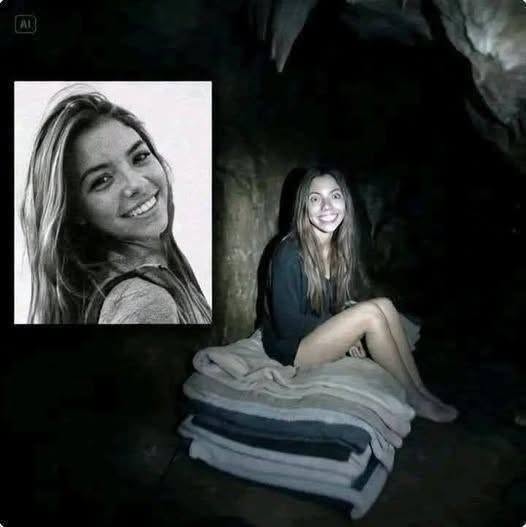
There, sitting quietly in the darkness, was a young woman.
She was alive. Her clothes were surprisingly clean. Her face showed none of the obvious exhaustion the explorers had expected from someone who had supposedly survived underground for years.
And she was smiling.
But when a flashlight illuminated her eyes, she did not blink.
One explorer whispered her name.
“Layan?”
She stared back at him.
Then her smile vanished.
She seized his wrist with astonishing strength, turned toward the darkness behind them, and whispered five words that would make everyone freeze.
“Please don’t go out there.”
Before anyone could ask what she meant, footsteps echoed through the chamber.
Slow footsteps.
Heavy footsteps.
And the unmistakable tapping of a wooden stick against stone.
Someone else was coming.
Someone who, it seemed, had been living with Layan all along.
The Promise Before Sunset
Three years earlier, Layan Mahmoud had been the kind of student who could spend an entire afternoon examining a single plant and still feel she had not learned enough.
At nineteen, she was studying environmental science at a university not far from the mountainous region of Santa Catalina. Her notebooks overflowed with sketches of leaves, observations about soil conditions, and handwritten questions about how certain species managed to survive in harsh environments.
She loved places where civilization seemed distant.
Mountains fascinated her most.
She loved how the temperature changed with elevation, how wildflowers emerged from cracks in seemingly lifeless rock, and how small pockets of vegetation could flourish in places that received very little sunlight.
Her father, Mahmoud, often joked that she knew the names of more plants than people.
“You’ll end up living in a forest one day,” he would tell her.
Layan would laugh.
“Only if the forest has a good library.”
Despite her adventurous spirit, she had never been careless. She researched trails before visiting them, carried basic safety equipment, and usually told her father exactly where she intended to go.
That morning was no different.
She woke before sunrise, ate a small breakfast, and carefully arranged her equipment across the kitchen table.
A digital camera. A notebook. A plant identification guide. A compact first-aid kit. Several sample bags. A flashlight. Water. Snacks. A fully charged phone.
She checked everything twice.
Her father watched from the doorway.
“Are you going alone again?”
“It’s a familiar trail, Dad.”
“That isn’t what I asked.”
She smiled and zipped her backpack.
“It’s only a short trip. I need a few samples for my university project.”
Mahmoud frowned.
“Mountains don’t care whether a trail is familiar.”
“I know. I’ll be careful.”
He moved closer and studied her face, searching for some reason to insist that she stay home.
But Layan was excited. Her eyes were bright with the anticipation of discovery.
“Promise me you’ll be back before sunset.”
She kissed his cheek.
“Don’t worry, Dad. I’ll be back before sunset.”
Those were the last words he would hear from her for three years.
At 8:17 that morning, a surveillance camera positioned near the entrance to a mountain trail recorded a small car pulling into the parking area.
Layan stepped out wearing hiking boots, dark trousers, and a light jacket. Her hair was tied back. A backpack hung from one shoulder.
She checked her camera, adjusted the straps on her bag, and glanced toward the rocky trail.
For several seconds, she stood completely still.
Then she started walking.
The camera recorded her passing between two weathered boulders and disappearing beneath a canopy of trees.
It was an ordinary image, the kind of recording no one would have thought about twice.
Later, investigators would watch those few seconds hundreds of times.
They would examine her movements, the direction of her gaze, the shadowed trail behind her, and even the final moment when the green fabric of her backpack vanished from view.
But the footage revealed nothing unusual.
No stranger followed her.
No suspicious vehicle appeared.
No visible danger waited along the trail.
A young woman had entered the mountains.
And somehow, she had disappeared.
The Night That Changed Everything
Mahmoud began worrying shortly after sunset.
At first, he tried to reassure himself.
Perhaps Layan had found an unusual plant and lost track of time. Perhaps her phone battery had died. Perhaps she had taken a longer route back to her car.
He called her at 6:42 p.m.
The call went unanswered.
He called again ten minutes later.
This time, the phone appeared to be switched off or outside network coverage.
He left a message.
“Layan, it’s getting dark. Call me when you hear this.”
Then he waited.
At seven-thirty, he called again.
At eight, he contacted one of her university friends.
Had Layan mentioned meeting anyone?
Had she changed her plans?
Did anyone know which section of the mountain she intended to explore?
The answers only deepened his concern.
She had told several classmates about a plant-collection trip, but no one had accompanied her.
By nine o’clock, Mahmoud was driving toward the trailhead himself.
His headlights cut through the darkness as he followed the winding mountain road. He gripped the steering wheel so tightly that his fingers ached.
When he reached the parking area, he saw her car.
It was exactly where she had left it.
He pulled beside it, stepped into the cold night air, and called her name.
“Layan!”
His voice echoed against the rocks.
There was no answer.
He searched around the car.
The doors were locked. Nothing appeared disturbed. There was no note beneath the windshield or message explaining a delayed return.
He tried calling her again.
Nothing.
Finally, he contacted the authorities.
By midnight, the first search personnel had arrived.
They questioned Mahmoud about her route, clothing, equipment, and physical condition.
Did she have any medical problems?
Was she familiar with the area?
Could she have deliberately gone somewhere else?
Mahmoud answered every question as calmly as he could.
Then one officer asked whether Layan might have wanted to disappear.
Mahmoud looked at him in disbelief.
“My daughter was supposed to come home for dinner.”
The officer apologized, explaining that investigators had to consider every possibility.
But Mahmoud could barely hear him.
He kept looking toward the dark entrance of the trail.
Somewhere beyond those trees, he believed, his daughter was waiting for someone to find her.
The Search That Found Nothing
By morning, the disappearance had become an organized search-and-rescue operation.
Rescue workers gathered at the trailhead with maps, radios, ropes, and medical equipment. Volunteers arrived from nearby communities. Experienced mountain guides offered to help navigate the more difficult terrain.
Trained search dogs were brought in.
The search teams divided the mountain into sections.
Some followed established hiking routes. Others descended into narrow ravines, investigated dry streambeds, and examined places where loose stones suggested a possible fall.
Helicopters scanned open slopes when weather and visibility permitted.
The teams searched for anything that might belong to Layan.
A shoe.
A torn piece of clothing.
A dropped water bottle.
A camera strap.
Even the smallest object could provide a clue.
But the mountains offered nothing.
On the second day, rescuers found several areas where the ground had recently shifted. They investigated each one carefully, looking for evidence that someone might have fallen through unstable rock.
Most of the cracks were too shallow to conceal a person.
Others were inaccessible without specialized equipment.
The search continued.
By the fourth day, Mahmoud had stopped returning home to sleep.
He remained near the command post, wrapped in a jacket, watching teams leave in the morning and return at night.
Every time a radio crackled, he turned toward it.
Every time someone approached him, he stood.
He learned to recognize the expressions on the rescuers’ faces before they spoke.
And each evening brought the same devastating conclusion.
Nothing.
On the sixth day, a volunteer following a stream discovered something unusual.
A small wooden owl.
It sat upright on a moss-covered tree stump near the water, its carved eyes facing the narrow trail.
The object was only a few inches tall.
Its surface was smooth, with delicate lines marking its wings and feathers.
It had not been thrown carelessly onto the ground.
It appeared deliberately positioned.
When the volunteer reported the discovery, investigators photographed the owl and examined the surrounding area.
Mahmoud recognized it immediately.
He had seen similar carvings in Layan’s room.
She collected small handcrafted animal figures, and owls were among her favorites.
But he could not say with certainty whether this one belonged to her.
The search dogs were brought to the location.
One dog followed the ground toward the tree, moving with unusual determination.
It sniffed the stump, circled the nearby stones, and approached a narrow rocky passage.
Then it stopped.
The handler encouraged it forward.
The dog turned back.
After several attempts, it refused to continue along the same route.
The handler could not explain the behavior with confidence. The rocks, flowing water, changing air currents, and overlapping scents could all have affected the animal.
But to Mahmoud, the moment became unforgettable.
He believed the dog had reached the place where his daughter’s trail ended.
He stood beside the tree for a long time.
Then he whispered into the mountain air.
“Layan, where are you?”
No answer came.
Only the sound of water passing over stones.
The Years of Silence
The first weeks were filled with urgency.
The following months were filled with questions.
As time passed, the number of active searchers declined. The operation shifted from emergency rescue to a missing-person investigation.
Authorities interviewed hikers who had visited the area. They reviewed available surveillance recordings, checked nearby roads, and examined reports of unidentified individuals.
Investigators considered several possibilities.
Layan might have fallen into an inaccessible crevice.
She might have become disoriented and wandered far beyond the original search area.
Someone might have encountered her on the trail.
Or she might have found an uncharted passage that led deep into the mountain.
But each theory encountered the same problem.
There was no evidence strong enough to establish what had happened.
The seasons changed.
Rain swept across the mountains. Streams filled and overflowed. Vegetation grew over paths that had once been carefully examined.
Winter arrived, followed by another spring.
Layan’s twentieth birthday passed.
Then her twenty-first.
Her university classmates graduated.
Some found jobs. Others continued their studies. A few moved to different cities.
Mahmoud watched photographs of graduation ceremonies appear online.
He tried to imagine his daughter among them, standing in a cap and gown with her familiar smile.
He had once promised to take a hundred photographs on the day she received her degree.
Instead, he kept her last photograph beside his bed.
The image showed Layan smiling in the sunlight, her camera hanging from her neck.
He dusted the frame every morning.
He never moved her books.
Her unfinished project remained on her desk, with a pencil resting across an open notebook.
Friends and relatives gently encouraged him to accept that she might never return.
But Mahmoud refused.
“Until someone proves otherwise,” he would say, “my daughter is alive.”
Some people called his faith admirable.
Others feared that it prevented him from healing.
Mahmoud did not care.
He continued visiting the mountain whenever he could.
Sometimes he walked the marked trails.
Sometimes he sat near the stream where the wooden owl had been found.
He spoke to Layan aloud, telling her about ordinary things.
A neighbor’s wedding.
A new tree planted in the garden.
A book he thought she would enjoy.
He did not know whether she could hear him.
He simply could not bear the thought of stopping.
Three years passed this way.
Then, on an otherwise unremarkable morning, everything changed.
The Cave No One Had Explored
The discovery began with a group of experienced cave explorers who were mapping a remote limestone formation several miles from the main hiking routes near Santa Catalina.
The team had no connection to Layan’s disappearance.
They were interested in underground geology, particularly the network of narrow passages formed by water moving through fractured rock over thousands of years.
A recent period of heavy rain had washed loose sediment from a hillside, revealing an opening partially hidden behind shrubs.
The entrance was barely wide enough for a person to crawl through.
From outside, it looked like a shallow crack.
But when one explorer directed a flashlight inside, the beam disappeared into an unexpectedly deep passage.
The team decided to investigate.
They secured their equipment, checked their lights, and entered one at a time.
The first section was difficult.
Loose stones covered the ground. The ceiling dropped so low that they had to move on their hands and knees. In some places, they squeezed sideways between rough limestone walls.
After several minutes, the passage widened.
The explorers emerged into a sloping corridor where cool air moved steadily through the darkness.
That airflow caught their attention.
It suggested the cave was connected to other openings somewhere deeper inside the mountain.
They continued.
Their footsteps echoed strangely.
Water dripped from the ceiling.
At one point, an explorer noticed scratches on a rock wall.
They appeared too regular to have been caused by natural erosion.
Farther along, another member of the team discovered a short section of old rope.
The fibers were worn and coated with mineral deposits, but the rope seemed to have been tied deliberately around a stone projection.
Someone had been there before.
As the team descended farther, they began noticing other unexpected details.
A flattened area of ground.
Several stacked stones.
A fragment of cloth caught beneath a rock.
Then they reached a chamber with a relatively even floor.
At first, everything looked ordinary.
There were pale limestone formations along the walls and a narrow channel through which water had once flowed.
But near the far side of the chamber, one explorer noticed an unusual shadow.
It had the shape of a seated person.
He raised his flashlight.
The shadow moved.
He stopped walking.
“There’s someone here.”
The others gathered behind him.
At first, they thought the person might be an injured explorer.
Perhaps someone had become trapped.
Perhaps the figure had entered through another opening.
But when they approached, the young woman sitting near the wall lifted her head.
Her eyes followed the moving lights.
She was wearing a clean, faded blue shirt and dark trousers.
Her hair was neatly tied back.
Her hands rested in her lap.
She looked thin and pale, but not as severely malnourished as someone might expect after years of isolation.
Most disturbingly, she did not seem surprised to see them.
She smiled.
The expression was broad and strangely motionless.
“Hello?” one explorer called.
She gave no answer.
“Are you hurt?”
Still nothing.
The man lowered his flashlight slightly, trying not to shine it directly into her face.
“Can you tell us your name?”
For several seconds, she remained completely still.
Then she whispered something.
The explorer leaned closer.
“Layan.”
He froze.
“Did you say Layan?”
The woman nodded.
Another member of the team immediately recognized the name.
He remembered news reports about a university student who had disappeared in the mountains several years earlier.
“Layan Mahmoud?”
She looked at him.
Then she nodded again.
No one spoke.
The explorers had entered an unfamiliar cave expecting to find rock formations.
Instead, they had apparently discovered a missing woman whose disappearance had remained unsolved for three years.
One of them reached for his radio.
Another crouched beside her.
“Layan, we’ve come to help you.”
For the first time, her expression changed.
The smile faded.
Her eyes widened.
And when the explorer moved toward the passage leading out of the chamber, she grabbed his wrist.
“Please,” she whispered.
He turned back.
“What’s wrong?”
Her fingers tightened around his arm.
“Please don’t go out there.”
The others exchanged confused looks.
One explorer assumed she feared another rockfall.
Another wondered whether the cave contained an unstable passage that they had failed to notice.
But Layan was not looking toward the entrance.
She was looking behind them.
Into a darker corridor near the bottom of the chamber.
Then the sound began.
Tap.
A pause.
Tap.
The unmistakable noise of wood striking stone.
Between the taps came footsteps.
Slow and deliberate.
Layan’s hands began to tremble.
And from the darkness, an elderly man appeared.
The Man With the Wooden Stick
The stranger was thin, with a deeply lined face and a beard streaked with gray.
He wore a loose, weathered garment and carried a wooden walking stick polished by years of use.
His clothes were simple but relatively clean.
He stopped when he saw the explorers.
For several seconds, he said nothing.
His eyes moved from one stranger to another.
Then he looked at Layan.
She stood abruptly, crossed the chamber, and clung to his sleeve.
“I told you,” she said in a strained voice. “I told you I didn’t want to go out.”
The old man lowered his stick.
“It’s all right.”
“No, it isn’t.”
He placed a hand gently on her shoulder.
“Look at me. You’re safe.”
One explorer stepped forward.
“Who are you?”
The man studied him.
“My name is Imran.”
“Do you live here?”
Imran hesitated.
“Sometimes.”
The answer only increased their confusion.
One of the explorers gestured toward Layan.
“Do you know who this woman is?”
“Yes.”
“How long has she been here?”
Imran looked at her before answering.
“A long time.”
The explorer took a breath.
“Is she Layan Mahmoud? The student who disappeared three years ago?”
Imran nodded.
“Then why didn’t anyone know she was alive?”
The old man lowered his eyes.
He seemed to be searching for an answer that would make sense to people who had just entered his world.
Finally, he said, “It is not as simple as you think.”
One explorer moved slightly closer to Layan.
“Did this man bring you here?”
She shook her head immediately.
“No.”
“Has he kept you from leaving?”
Her answer took longer.
She looked toward the passage.
Then back at Imran.
“No,” she whispered. “He saved me.”
The explorers did not know what to believe.
Layan appeared frightened at the possibility of leaving, yet she also seemed deeply attached to the man who had been living with her.
Imran showed no obvious aggression, but his explanations were incomplete.
And there was one question neither of them seemed willing to answer.
Why had no one contacted the outside world?
The team decided not to confront him further underground.
They offered Layan water and a small energy bar.
She accepted the water, took only a few sips, and placed it beside her.
When someone suggested returning to the surface, she recoiled.
“No.”
“Layan, your family has been looking for you.”
Her expression tightened.
“My family?”
“Yes. Your father is still waiting.”
For a moment, the cave became silent.
She stared at the explorer as though he had spoken words from a language she had almost forgotten.
Then her lips moved.
“My father?”
The explorer nodded.
“He’s alive. He hasn’t stopped searching for you.”
Layan covered her mouth with both hands.
Her breathing grew uneven.
Imran stepped closer.
“Sit down,” he advised quietly.
But Layan remained standing.
She looked toward the passage that led to the outside world.
Then she asked a question no one expected.
“Does he still live in the same house?”
The explorer swallowed.
“I believe so.”
She lowered her head.
And for the first time since they found her, tears appeared in her eyes.
The Rescue That Became an Investigation
Bringing Layan to the surface was not a simple matter.
She was physically capable of walking, although her movements were cautious and she appeared to favor one leg.
The greater obstacle was her fear.
Every time the explorers began preparing to leave, she became visibly distressed.
She asked whether the passage would collapse.
She wanted to know if the entrance was still open.
She repeatedly questioned whether the people above were truly rescue workers.
The explorers recognized that forcing her to move could make matters worse.
They contacted emergency personnel and explained the unusual circumstances.
A rescue team arrived with medical equipment and additional lighting.
After assessing the cave’s known hazards, they planned a carefully supervised evacuation.
Imran remained beside Layan.
He spoke to her in a low voice, reminding her to breathe slowly and focus on one movement at a time.
“One step,” he told her. “Then another.”
She looked at the passage.
“What if the stones move?”
“We’ll stop if we hear anything.”
“What if we can’t find the opening?”
“We have guides.”
“What if I can’t do it?”
Imran held out his hand.
“You’ve already done harder things.”
It took repeated reassurance before she agreed to leave the chamber.
As they moved through the narrow passage, Layan kept one hand against the wall.
Occasionally, she stopped and listened.
The rescuers could hear distant dripping water and the scrape of boots against stone.
Layan seemed to hear something else.
Every unfamiliar noise made her turn.
At one particularly narrow section, she froze completely.
Her breathing became rapid.
“I can’t.”
The medic accompanying her crouched nearby.
“You’re doing well. We can stop here.”
Layan shook her head.
“The last time I tried this—”
Her voice broke.
Imran gently interrupted.
“This is not the last time.”
She stared at him.
He pointed toward the rescuers.
“You’re not alone.”
After a long pause, she continued.
When the team finally reached the cave entrance, sunlight spilled across the ground.
Layan stopped just inside the opening.
The brightness made her squint.
For several moments, she seemed unable to move.
Outside, the air carried the scent of warm vegetation and damp earth.
Birds called from nearby trees.
A breeze moved across the hillside.
Ordinary sounds.
Ordinary sensations.
But to Layan, they seemed almost overwhelming.
She lifted a hand in front of her face.
Sunlight touched her fingers.
She stared at it.
Then she stepped outside.
A rescue worker placed a blanket around her shoulders.
Another guided her toward a medical vehicle.
Imran emerged several minutes later.
Before he could follow her, police officers approached him.
They asked him to accompany them for questioning.
He did not resist.
Layan saw the exchange and immediately became distressed.
“Where are you taking him?”
“Only to ask some questions,” an officer replied.
“He didn’t hurt me.”
“We need to understand what happened.”
“He saved my life.”
The officer nodded.
“We’ll listen to everything you have to say.”
But as Imran was led away, Layan reached for his sleeve one final time.
He looked back.
“You’ll be all right,” he said.
She shook her head.
“You don’t know that.”
Imran’s face softened.
“No,” he admitted. “But I believe it.”
Then they were separated.
For the first time in three years, Layan was leaving the mountain without him.
A Father’s Impossible Phone Call
Mahmoud was at home when the telephone rang.
It was late afternoon.
He had spent part of the day sorting through old documents related to the missing-person investigation.
The telephone number was unfamiliar.
He almost ignored it.
Then he answered.
“Mr. Mahmoud?”
“Yes.”
“This is Officer Kareem. I’m calling about your daughter.”
Mahmoud’s heart began to race.
Over the years, he had received several calls about possible sightings and unidentified personal belongings.
Each had raised his hopes.
Each had ended in disappointment.
He gripped the phone.
“What about her?”
“We believe we’ve found Layan.”
The room seemed to tilt.
Mahmoud sat down.
“Found what?”
“We’ve found your daughter. She’s alive.”
For several seconds, he could not speak.
Then he began shaking his head.
“No.”
“Mr. Mahmoud—”
“No. You need to be sure.”
“We have confirmed her identity through the information available to us. She’s receiving medical care.”
Mahmoud pressed a hand against his chest.
“She’s alive?”
“Yes.”
“Can she speak?”
“Yes.”
“Does she remember me?”
The officer paused.
“She asked about you.”
Mahmoud began to cry.
He had imagined this moment thousands of times.
In some versions, Layan appeared at the front door.
In others, a stranger found her in a distant town.
Sometimes he dreamed she simply walked into the kitchen and asked what was for dinner.
But nothing had prepared him for the sound of a real voice saying she was alive.
“Where is she?”
The officer gave him the hospital’s location.
Mahmoud left almost immediately.
He barely remembered the drive.
At the hospital, a member of staff guided him through a corridor toward a quiet examination room.
His steps slowed as he approached the door.
He was suddenly afraid.
Afraid that something had been misunderstood.
Afraid that he would open the door and find a stranger.
Afraid that three years of hope would disappear in a single moment.
Then the door opened.
And Layan was there.
She sat on the edge of a hospital bed, wearing a clean sweater someone had given her.
Her hair was shorter than he remembered.
Her face was thinner.
A faint scar crossed one eyebrow.
But her eyes were the same.
“Layan?”
She looked up.
For a moment, she seemed unable to recognize the older man standing in the doorway.
His hair had grown grayer.
The lines around his eyes were deeper.
Three years of grief had changed him.
Then she whispered, “Dad?”
Mahmoud crossed the room.
He wrapped his arms around her.
She remained stiff for one brief moment.
Then her hands rose and clutched the back of his jacket.
He buried his face against her shoulder.
“My daughter. My daughter.”
She began trembling.
“I’m sorry.”
He pulled back.
“What?”
“I’m sorry I didn’t come home.”
Mahmoud took her face between his hands.
“Don’t say that.”
“I promised.”
He shook his head.
“You’re here now.”
“But I promised before sunset.”
His expression broke.
He held her again.
For several minutes, neither said anything.
There were too many questions.
Too many missing birthdays.
Too many nights of fear.
For the moment, all that mattered was that she was breathing, speaking, and holding him.
Eventually, Mahmoud stepped back.
He examined her carefully.
“Are you hurt?”
“My leg is sometimes painful.”
“Did someone take you?”
She hesitated.
“No.”
“Then what happened?”
Layan looked toward the window.
Outside, a tree swayed gently in the wind.
She watched it for a long time.
Then she said, “I fell.”
The Day the Mountain Opened Beneath Her
Layan’s account began with a detail investigators had never known.
On the morning she disappeared, she had not intended to walk far from the established trail.
She was searching for a rare plant that grew in cool, shaded places, particularly near limestone outcrops.
After walking for almost two hours, she noticed a cluster of vegetation beside a narrow ravine.
The plants looked similar to something she had been studying.
She left the main path to take photographs.
At first, the ground seemed stable.
She climbed across several flat rocks and followed a shallow channel where rainwater had recently flowed.
The vegetation became thicker.
Beyond it, she saw a narrow opening between two walls of stone.
Cool air moved through the gap.
She approached out of curiosity.
Inside, she discovered an area sheltered from direct sunlight.
Small plants grew along the edges of the stone.
She took several photographs, recorded notes, and collected a limited sample for her project.
Then she heard a cracking sound.
At first, she thought a branch had broken.
She turned.
A small stone rolled down the slope behind her.
Then another.
She looked up.
A section of loose rock shifted.
Before she could react, the ground beneath her right foot gave way.
She screamed.
Her backpack struck the wall as she slipped.
She grabbed at a projecting stone, but it broke loose in her hand.
Then she fell through a narrow opening into darkness.
Her body struck a sloping surface.
She rolled, hit another rock, and landed heavily on the ground below.
Pain exploded through her leg.
She tried to move.
Something was terribly wrong.
She reached for her flashlight, but her hands were shaking.
The light revealed a narrow underground chamber littered with broken stones.
Above her was the opening through which she had fallen.
It was much farther away than she had expected.
She tried to stand.
Her injured leg collapsed beneath her.
She screamed again.
No one answered.
For the next several hours, she called for help whenever she had enough strength.
Her voice echoed through the chamber.
Sometimes she thought she heard a reply.
But each time she stopped shouting, the cave returned to silence.
She checked her phone.
There was no signal.
Her screen was cracked, but the device still worked.
She tried making an emergency call.
It failed.
She held the phone above her head and moved toward the walls, searching desperately for a connection.
Nothing.
As the hours passed, the temperature dropped.
Her leg swelled.
She became increasingly thirsty.
She knew she needed to conserve her supplies, but pain and fear made it difficult to think clearly.
She ate part of her food.
She drank a small amount of water.
Then she tried crawling toward what appeared to be a passage.
Her leg dragged painfully behind her.
After several yards, she encountered a steep drop.
She could hear water somewhere below.
There was no safe way down.
She returned to the place where she had fallen.
By the time her phone battery died, she had lost all sense of time.
She curled against the wall and waited.
Sometimes she slept.
Sometimes she woke crying.
Sometimes she screamed until her throat became too painful to continue.
She later struggled to remember exactly how long she remained alone.
Her memories of those early days were fragmented by exhaustion, dehydration, and pain.
But she remembered one particular moment clearly.
She had stopped calling for help.
She was lying on the cold ground when she heard a voice.
“Who’s there?”
At first, she thought she was dreaming.
Then the voice came again.
“Can you hear me?”
She tried to answer.
Only a weak sound emerged.
A light appeared somewhere above and to her left.
Footsteps followed.
Then a man’s face emerged from the darkness.
He was older, with a gray beard and deeply lined features.
He stared at her in astonishment.
“What happened to you?”
Layan began crying.
“I fell.”
The man approached carefully.
He examined her injured leg without moving it unnecessarily.
Then he gave her water.
“My name is Imran,” he said.
She could barely speak.
“Please help me.”
He nodded.
“I will.”
Those two words, Layan would later say, were the first reason she believed she might survive.
How Imran Kept Her Alive
Imran knew the cave system better than anyone Layan had ever met.
For decades, he had traveled through the mountains, collecting edible plants, repairing old paths, and using sheltered limestone chambers as temporary resting places.
His knowledge had been passed down through family members who had worked in the region long before the surrounding trails became popular with hikers.
He knew which passages flooded after rain.
He knew where underground water emerged.
He knew which narrow cracks connected to larger chambers.
And he knew that the place where Layan had fallen was dangerous.
The opening above her was unstable.
Loose stones hung along its edges.
The passage through which Imran had reached her was steep and narrow.
Moving an injured person through it without proper rescue equipment would be extremely risky.
Imran first focused on keeping her alive.
He brought drinking water and food from his supplies.
He helped her move to a safer, more sheltered area of the cave, where she could lie on a dry surface.
He used the clean materials available to him to cover her wounds and support her injured leg.
These improvised measures could not replace professional medical care, but they provided some protection while she remained trapped.
Layan was weak, frightened, and in severe pain.
She repeatedly asked him to take her home.
Imran assured her that he would try to find a safe route.
But the cave had changed.
The rockfall that caused her accident had blocked part of a passage he previously used.
The remaining route involved a narrow climb over unstable stones.
Imran attempted to assess it several times.
On one occasion, when they tried moving through a difficult section, more rocks shifted nearby.
The noise terrified Layan.
She began crying and begged him to stop.
Imran realized that attempting to carry her through the passage could cause another accident.
“We can’t go this way,” he told her.
“Then find another.”
“I’ll try.”
“Please.”
He nodded.
But days passed without a solution.
As Layan’s immediate condition gradually improved, Imran moved her to an older chamber elsewhere in the underground network.
This was the place the explorers would eventually discover.
Unlike the rough chamber where she had fallen, it had once been used by local workers as a storage room.
The ground had been leveled.
Small niches had been carved into the rock.
There were ventilation openings high along one wall.
A narrow channel carried groundwater through a protected section of the chamber.
Imran had kept basic supplies there for years.
He stored dry clothing, blankets, simple cooking utensils, rope, and containers for collecting water.
Layan was astonished when she first saw it.
“This is inside the mountain?”
Imran smiled faintly.
“People were using these places before either of us was born.”
The chamber was not comfortable in the ordinary sense.
There was no electricity, proper bed, or modern sanitation.
The damp air could become unpleasant, and the temperature fluctuated.
But compared with the place where she had fallen, it was safer and more manageable.
Imran cleaned the floor regularly and maintained a separate area for waste.
He brought fresh clothing and supplies through a secondary opening on the far side of the mountain.
He washed what he could and dried items in ventilated passages.
He also gathered food outside, supplementing stored provisions with supplies obtained during his trips.
That hidden access route would later explain how Layan had survived for so long without the extreme physical deterioration rescuers initially expected.
She had not spent three years starving in complete darkness.
She had received food, water, clothing, and shelter.
Yet the existence of those resources raised a more troubling question.
If Imran could leave the cave, why had Layan remained there?
And why had he not informed anyone that the missing student was alive?
The First Time She Tried to Escape
For the first several months, Layan believed her stay in the cave would be temporary.
Every morning, she asked Imran about the outside world.
Had the weather improved?
Were the mountain paths safe?
Had he found another way through the rocks?
Could he take a message to her father?
Imran answered some questions patiently and avoided others.
He told her that certain passages remained dangerous.
He said he had not encountered anyone during his trips outside.
He promised they would continue looking for a safe way out.
But Layan increasingly felt trapped by uncertainty.
As her leg healed, she began exploring the passages near their shelter.
She made small maps in an old notebook Imran gave her.
She marked turns with stones.
She counted steps between chambers and learned to distinguish different sounds.
Water dripping onto limestone produced a gentle tapping noise.
Air moving through narrow cracks sometimes created a low whistle.
A distant rockfall could sound like thunder rolling beneath the ground.
She studied these sounds because she believed they might help her find a way out.
Then, one day, she heard voices.
At first, the sound was faint.
Two people seemed to be speaking somewhere beyond a side passage.
Layan stopped.
She listened carefully.
There it was again.
Human voices.
Her heart began pounding.
“Hello!” she shouted.
The sounds continued.
She hurried toward them.
“Please! I’m here!”
She followed the passage around a bend, ignoring the growing pain in her leg.
The voices seemed closer now.
She imagined rescuers examining the mountain.
Perhaps they had finally discovered an entrance.
Perhaps her father was nearby.
She began moving faster.
Then the passage narrowed.
She stepped onto a patch of loose gravel.
Her injured leg twisted beneath her.
She fell against a wall and slid down a short rocky slope.
The impact reopened an old wound and left her unable to stand comfortably.
She screamed for help.
The voices disappeared.
Only echoes answered.
Later, Imran found her after searching the neighboring passages.
She was sitting on the ground, crying uncontrollably.
“There were people,” she insisted.
He looked around.
“Where?”
“Down there. I heard them.”
Imran listened.
Then he struck his walking stick against the stone floor.
The sound traveled down the passage and returned in distorted fragments.
He called out a few words.
Seconds later, their echoes came back, stretched and altered by the tunnels.
Layan stared at him.
“The cave does strange things with sound,” he explained.
She shook her head.
“No. I heard people.”
“Perhaps you did. But there is no one here now.”
He helped her return to the shelter.
For several days afterward, she barely spoke.
The incident changed something in her.
Before, she had believed the mountain was an obstacle she needed to overcome.
Afterward, she began treating it as a warning.
Every attempt to leave seemed to bring pain.
Every hopeful sound ended in disappointment.
Over time, fear transformed her understanding of the cave.
She began to believe that the mountain was somehow keeping her inside.
Not because she had discovered a supernatural force, but because repeated frightening experiences had made escape feel more dangerous than staying.
The cave became both her prison and her refuge.
The outside world represented family, freedom, sunlight, and everything she missed.
But it also represented unstable rocks, confusing passages, physical pain, and the possibility of another terrible fall.
Gradually, the certainty of her familiar underground environment began to outweigh the uncertainty of leaving it.
Imran noticed the change.
At first, he encouraged her to practice walking farther.
He suggested brief visits to the brighter passages.
He reminded her that the outside world still existed.
But when she became frightened, he stopped pushing.
He believed he was protecting her from further distress.
In reality, his decision allowed her fear to grow.
Without professional help or regular contact with other people, Layan became increasingly dependent on the routines they had created.
A Life Beneath the Mountain
By the second year, Layan had developed a daily routine unlike anything she could have imagined as a university student.
She woke according to the faint light entering through the ventilation openings.
She washed using the water Imran collected and stored.
She helped organize supplies, cleaned the shelter, and prepared simple meals.
On days when she felt strong enough, she explored nearby passages and recorded observations about the cave’s environment.
Her scientific curiosity had never completely disappeared.
She was fascinated by the way moisture accumulated on certain walls, the temperature differences between chambers, and the small organisms living near underground water.
She began filling pages with descriptions and drawings.
These activities gave her days structure.
They also helped her preserve something important: the part of herself that had existed before the accident.
Imran sometimes watched her drawing and shook his head in amusement.
“You can find something interesting in any place.”
Layan smiled.
“Everything is interesting if you look closely enough.”
Occasionally, they talked about her old life.
She described her university classes.
She told him about her father, who cooked too much rice whenever he was nervous.
She remembered the little garden behind their house and the afternoon thunderstorms that made the windows rattle.
But those conversations became increasingly difficult.
The longer she stayed underground, the more painful her memories felt.
She stopped asking what year it was.
She stopped counting the exact number of days.
Sometimes she worried that her father had moved away.
Sometimes she imagined he had become ill.
And sometimes she feared that he had stopped looking for her.
Those thoughts were so painful that she began avoiding them.
When Imran asked whether she missed home, she often replied, “I don’t want to talk about it.”
He respected her silence.
Their relationship developed into an unusual form of companionship.
They ate together.
They shared stories.
They argued occasionally over supplies and routines.
When Layan was frightened by a distant sound, Imran reassured her.
When he became exhausted after a long journey to obtain provisions, she helped care for him.
Neither believed they were living an ordinary life.
But they had created a fragile arrangement that allowed them to get through each day.
There were moments when Layan almost convinced herself she could remain there forever.
Then she would dream about her father.
In those dreams, she was always walking toward their front door.
Sometimes she reached it.
Sometimes the ground opened before she could touch the handle.
And sometimes she heard her father calling her name from the other side, but she could not make herself answer.
She would wake with tears on her face.
Then morning would come.
She would clean the shelter, record another observation, and pretend the dream had never happened.
The Question Imran Could Not Answer
When investigators heard Layan’s account, they faced a complicated situation.
Imran had apparently rescued an injured woman and provided the food, water, and shelter that helped her survive.
But he also knew she was missing.
He had access to the outside world.
And for three years, he had failed to alert authorities or contact her family.
During questioning, he explained that he had initially feared leaving Layan alone while she was seriously injured.
Later, when she became physically stronger, she was increasingly terrified of moving through the underground passages.
He claimed he had suggested leaving many times.
According to him, Layan repeatedly refused.
“I didn’t want to hurt her,” he told investigators.
One officer leaned forward.
“Did you know her father was searching for her?”
Imran lowered his gaze.
“I knew she had a family.”
“Did you know she had been reported missing?”
“I suspected.”
“Then why didn’t you tell anyone?”
The old man remained silent.
The officer repeated the question.
Finally, Imran answered.
“At first, I thought I could bring her out myself. Later, I was afraid that strangers would force her to leave before she was ready.”
“That decision wasn’t yours to make.”
Imran did not argue.
“I understand that now.”
Investigators questioned him about the secondary entrance.
He described how he reached the surface through a narrow route on the far side of the mountain.
They asked where he obtained food and supplies.
He explained that he used stored provisions and replenished them during occasional trips outside.
They examined the chamber and found clothing, containers, blankets, notes, and evidence that the area had been occupied over an extended period.
They also recovered some of Layan’s notebooks.
Her writing helped support important parts of her account.
The pages described the original accident, the pain in her leg, her attempts to navigate the passages, and her growing fear of leaving.
Some entries were organized scientific observations.
Others were personal reflections.
One passage read:
I thought the most difficult part would be finding the way out. Now I think the most difficult part is believing I can survive leaving.
The investigators recognized that her situation could not be understood through a single explanation.
She had suffered a serious accident.
She had experienced prolonged isolation.
She had developed a strong attachment to the man who provided her with food and safety.
And she had become terrified of returning through passages associated with pain and danger.
None of those circumstances erased the need to examine Imran’s conduct.
But they helped explain why Layan had not simply walked out.
In the fictional case, the investigation did not establish that Imran had abducted her or physically imprisoned her.
Nevertheless, authorities criticized his failure to report her presence and examined whether that failure could carry legal consequences.
Layan remained adamant about one thing.
“He saved my life,” she told investigators.
Then, after a pause, she added something that surprised even her father.
“But I wish he had told someone.”
Why She Smiled Without Blinking
The explorers had been particularly disturbed by Layan’s expression when they discovered her.
She had smiled continuously.
She had remained unnaturally still.
And when a flashlight illuminated her face, she barely reacted.
Some initially interpreted her appearance as evidence of something mysterious.
But the doctors and psychological specialists who evaluated her approached the behavior differently.
They considered the effects of prolonged isolation, stress, anxiety, and exposure to an unfamiliar social situation.
Layan explained that she had become accustomed to the cave’s dim lighting.
Direct beams of light felt overwhelming.
She had also spent years interacting primarily with one person.
When several strangers suddenly appeared, speaking loudly and moving flashlights around her, she did not know how to respond.
She smiled because she was frightened.
She remained still because she was trying to understand whether the encounter was real.
And she was not consciously aware of how rarely she blinked during those moments.
The clinicians did not treat that single observation as proof of any particular diagnosis.
Instead, they considered it alongside her medical condition, personal history, and emotional responses.
The more significant issue was her fear of leaving.
Layan explained that she had repeatedly imagined rescue.
But whenever she pictured actually returning to the surface, she became overwhelmed.
“What if I go back and everything is different?” she asked.
“What if no one recognizes me?”
“What if my father doesn’t want to see me after all this time?”
Those questions revealed that her fear was not limited to the physical dangers of the cave.
She was afraid of the world that had continued without her.
Three years had passed.
She had missed birthdays, family events, university classes, and countless ordinary experiences.
Her peers had built careers and relationships.
Her father had grown older.
The thought of returning to those changes frightened her almost as much as the prospect of another fall.
Her recovery team explained that rebuilding confidence would require time.
She needed medical care, psychological support, and the freedom to regain control over everyday decisions.
Most importantly, she needed to learn that leaving the cave did not mean losing the sense of safety she had developed there.
It meant discovering that safety could exist somewhere else.
Learning to Live in the Light
Layan’s first weeks at home were unexpectedly difficult.
Mahmoud had imagined that bringing his daughter back would end the nightmare.
He soon understood that finding her was only the beginning.
She struggled with crowded rooms.
The ringing of a telephone startled her.
Unexpected visitors made her anxious.
At night, she sometimes woke confused, reaching for the wall beside her bed as though expecting to feel cool limestone beneath her fingers.
She disliked sleeping with the door fully closed.
She found supermarkets exhausting.
After years of eating simple meals and living with very few possessions, the sight of brightly lit shelves filled with hundreds of products overwhelmed her.
Her father tried to make everything comfortable.
He bought her new clothes.
He prepared her favorite foods.
He invited relatives to welcome her home.
But Layan quickly became exhausted.
One evening, after several visitors had left, she sat at the kitchen table and began crying.
Mahmoud hurried toward her.
“What’s wrong?”
“Nothing.”
“Are you in pain?”
She shook her head.
“Then tell me.”
She struggled to explain.
“Everyone wants me to be happy.”
Mahmoud sat beside her.
“Of course they do.”
“But I don’t know how.”
He stared at her.
She wiped her eyes.
“I wanted to come home for three years. Now I’m here, and everything feels too loud.”
Mahmoud reached across the table.
“You don’t have to be happy every minute.”
She looked at him.
“You don’t?”
“No.”
“What if I never feel normal again?”
He thought carefully before answering.
“Then we will find a new normal together.”
That conversation became an important moment in their relationship.
Mahmoud stopped trying to fill every silence.
He began asking Layan what she needed instead of assuming he knew.
Sometimes she wanted company.
Sometimes she preferred to sit alone in the garden.
Sometimes she wanted to talk about the cave.
Other times, she could not bear to hear its name.
Gradually, she began sleeping more comfortably.
She resumed short walks.
She started using her camera again.
At first, she photographed ordinary objects around the house.
A cup beside the window.
Rainwater collecting on a leaf.
Sunlight falling across an empty chair.
Then she began photographing plants.
Her hands seemed to remember the work she had once loved.
She carefully adjusted the lens, examined the light, and waited for the right moment.
One afternoon, Mahmoud found her kneeling beside a small flower in the garden.
She was smiling.
Not because someone had asked her to.
Not because she was trying to prove she had recovered.
She was smiling because she had discovered something beautiful.
He stood in the doorway and watched without interrupting.
For the first time since her return, he felt that his daughter was beginning to find her way back to herself.
The Return to the University
Several months after her rescue, Layan visited her university.
She had been nervous for days.
The buildings were familiar, but the students passing through the corridors were strangers.
Most of her former classmates had already graduated.
New notices covered the bulletin boards.
Some of her old professors had moved to different departments.
Even the laboratory had changed.
For a moment, she felt like someone visiting the remains of a life that no longer belonged to her.
Then one of her former professors recognized her.
“Layan?”
She turned.
The woman stood frozen in the doorway.
Then she approached and embraced her.
“I can’t believe you’re here.”
Layan smiled.
“Neither can I.”
They talked for nearly an hour.
Her professor asked about her recovery, her notebooks, and whether she still wanted to continue studying environmental science.
Layan hesitated.
“I don’t know if I can.”
“Why?”
“I’ve forgotten so much.”
Her professor shook her head.
“Knowledge can be relearned.”
Layan looked down.
“I feel like everyone has moved ahead.”
“Life isn’t a race, Layan.”
For the first time, she considered that her education might not be over.
She did not have to return immediately.
She did not have to complete the same program on the same schedule.
She could begin with one course.
Then another.
Eventually, she arranged a gradual return to her studies.
Her experience had changed the way she understood nature.
Before the accident, mountains had represented adventure and discovery.
Now she knew they could also be places of danger, isolation, and extraordinary human vulnerability.
She became especially interested in outdoor safety, environmental mapping, and the psychological challenges associated with survival in remote environments.
She wanted future students to understand that curiosity should always be accompanied by preparation.
But she also wanted them to know that surviving a terrible experience did not mean abandoning the things they loved.
One day, a classmate asked whether she would ever hike again.
Layan considered the question.
“Yes,” she said.
“Aren’t you afraid?”
“Of course.”
“Then why go back?”
She smiled.
“Because I don’t want fear to make every decision for me.”
The Wooden Owl
Almost a year after her rescue, Layan returned to the mountain with her father.
The journey was carefully planned.
They traveled in daylight, remained on established paths, and arranged to meet an experienced local guide.
Layan had spent weeks considering whether she was ready.
She did not intend to enter the cave.
She simply wanted to see the place where her old life had ended and her new life had eventually begun.
The morning was clear.
Sunlight illuminated the rocky slopes, and a cool breeze moved through the trees.
As they approached the familiar trailhead, Layan recognized the parking area immediately.
She stopped beside the car.
For several seconds, she stared at the path.
Her father waited beside her.
“Are you all right?”
She nodded slowly.
“I remember standing here.”
He looked toward the trees.
“That morning?”
“Yes.”
“What were you thinking?”
She gave a small smile.
“That I needed to get home before dinner.”
Mahmoud swallowed.
Neither spoke for a while.
Then they began walking.
They followed the marked trail until they reached the stream where the wooden owl had been found.
Layan recognized the surrounding landscape.
The sound of flowing water was familiar.
So was the narrow path between the rocks.
But the place looked different in daylight, surrounded by people she trusted.
She approached the tree stump.
For a moment, she simply stood there.
Then she noticed something.
A small wooden figure rested in a protected hollow near the base of the tree.
It resembled the owl found during the original search.
Its carved wings were worn, and its surface had darkened with age.
Layan picked it up carefully.
She turned it over.
On the underside, beneath a thin layer of dirt, were several tiny engraved words.
She rubbed the wood with her thumb until she could read them.
If you make it out, remember that you were stronger than you believed.
Her eyes filled with tears.
Mahmoud stepped closer.
“Do you know who wrote that?”
Layan looked at the inscription for a long time.
Then she nodded.
“Imran.”
She remembered watching him carve small objects during quiet evenings in the cave.
Sometimes he made birds.
Sometimes he made flowers.
He had once told her that an owl could find its way through darkness without forgetting the world beyond it.
She had never known he had made one for her.
Whether he had placed it there himself or entrusted it to someone else, she could not say.
But the message felt unmistakably personal.
Mahmoud studied the little carving.
“Do you miss him?”
Layan looked toward the mountains.
“Sometimes.”
Her father said nothing.
“He helped me survive,” she continued. “But he also made mistakes.”
Mahmoud nodded.
“Both things can be true.”
She held the owl against her chest.
For years, she had struggled to understand how someone could protect her and still fail to get her the help she needed.
Now she was beginning to accept that gratitude did not require her to ignore what had gone wrong.
She could appreciate the life Imran had helped preserve.
She could also acknowledge the years she had lost.
And she could choose what happened next.
The Choice to Go Home
Before leaving, Mahmoud asked whether Layan wanted to walk closer to the cave entrance.
She turned toward the distant hillside.
The rocks rose sharply above the trees.
Somewhere beneath them lay the chamber where she had spent three years.
She imagined the familiar stone walls.
The sound of dripping water.
The old blankets.
The notebooks stacked in a dry corner.
For a moment, she felt a strange ache of longing.
The cave had frightened her, isolated her, and taken away years she could never recover.
But it had also become familiar.
She had learned to survive there.
She had discovered strength she had not known she possessed.
And she had spent countless nights believing she would never see her father again.
Now he stood beside her.
Waiting.
Not forcing her.
Not deciding for her.
Simply waiting for her answer.
“Do you want to go inside?” he asked.
Layan shook her head.
“No.”
“Are you sure?”
“Yes.”
He looked relieved.
“Why not?”
She took his hand.
“Because this time, I get to choose when I go home.”
They turned away from the mountain.
As they walked toward the parking area, Layan glanced back once.
She did not see a monster hiding among the rocks.
She did not imagine that the mountain was calling her name.
She saw trees, stone, shadows, and sunlight.
A beautiful but dangerous place.
A place that had changed her life.
But no longer a place that controlled it.
In the years that followed, Layan continued her education, strengthened her relationships, and slowly rebuilt her confidence.
She still experienced moments of fear.
Certain sounds reminded her of falling rocks.
Narrow spaces could make her uneasy.
Sometimes she dreamed of the cave.
But those memories no longer defined every part of her life.
On the anniversary of her rescue, she returned to the mountains with her father.
They took a photograph beside the trail.
Layan held the little wooden owl in one hand.
Her father stood beside her, smiling.
When the photograph was taken, she looked directly into the camera.
Her expression was natural.
Her eyes were bright.
And this time, when the sunlight touched her face, she blinked.
The photograph eventually became one of Mahmoud’s most treasured possessions.
He placed it beside the last picture taken before his daughter’s disappearance.
Two photographs.
Three years apart.
In the first, a young woman stood at the beginning of an adventure she could never have imagined.
In the second, the same woman stood beside her father after surviving something that had changed her forever.
The difference was not simply in her appearance.
It was in the meaning of her smile.
The first belonged to a girl who believed she knew exactly where life would take her.
The second belonged to a woman who had learned that even when life becomes unrecognizable, it is possible to begin again.
For three years, Layan Mahmoud had lived beneath a mountain while the world continued above her.
She had lost time, opportunities, and a sense of safety.
But she had not lost her ability to hope.
And when she finally walked away from the cave, she understood something that no university textbook could have taught her.
Survival was not simply the act of remaining alive. It was finding the courage to live again.
The mountain would always be part of her story.
But it would never again be the place where her story ended.