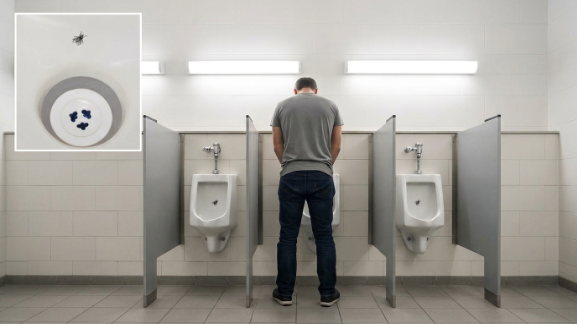
In the early 1990s, the management at Amsterdam’s Schiphol Airport had a problem. The men’s bathrooms were expensive to clean, and a significant part of that cost came down to one simple issue: men missing the urinal.
The solution they landed on cost almost nothing.
An airport facilities manager named Aad Kieboom had an idea. Instead of installing more signage, hiring more cleaners, or redesigning the bathrooms entirely, he proposed adding a small etching of a fly just above the drain of every urinal. The logic was simple: give men something to aim at, and they will aim at it.
He was right.
The etching is small, realistic enough to look like a real fly at first glance, and positioned just off-center above the drain. Men stepping up to the urinal notice it almost immediately, and without being asked, without any signage, without any instruction whatsoever, they aim at it. The instinct is apparently irresistible.
The results were striking. Spillage, the polite term for urine that ends up on the floor rather than in the drain, dropped by 80 percent. The cost of cleaning the men’s bathrooms fell significantly, all from a tiny etching that cost almost nothing to implement.
The idea spread. Similar fly etchings and stickers appeared in urinals at JFK Airport in New York, Munich Airport in Germany, and Changi Airport in Singapore. Fly stickers are now sold commercially for use in homes, offices, restaurants, and schools.
The Schiphol fly also caught the attention of the academic world. When Richard Thaler won the Nobel Prize in Economics in 2017 for his work on behavioral nudges, the small changes in environment that influence human behavior without restricting choice, he cited the airport urinal fly as his favorite example.
The Tiny Fly That Saved Airports Millions in Bathroom Cleaning Costs