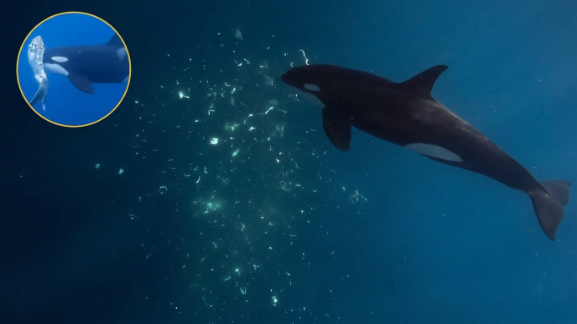
Marine biologist Joanna Ayres was diving in the Gulf of California when she witnessed something no scientist had ever recorded before.
Below the surface, an adult female orca was holding a sharptail sunfish in her mouth. Sunfish are among the heaviest bony fish on Earth, capable of growing over six feet long and weighing over 4,000 pounds. The internal organs had already been hollowed out.
Then a male orca came soaring into view, belly up, at full speed.
He smashed his head directly into the fish. The sunfish exploded in a plume of debris. Bits of fish floated through the water as a juvenile orca darted in to gobble up the pieces.
Ayres’ reaction, caught on camera, was immediate. “Oh my god, oh my god, oh my god. Holy sh*t. What the heck?”
The footage, published this week in the journal Frontiers in Ethology, documents what researchers are calling a previously unknown collaborative hunting strategy. One orca holds the prey in place. Another rams it at full force, nose or belly first, reducing the massive fish to bite-sized pieces that the group can then share.
What makes it even more remarkable is that scientists aren’t entirely sure they’re doing it for food. Orcas are well documented playing with their prey, passing dying animals between them like a game of hot potato. The sunfish ramming may serve a similar purpose, giving younger orcas a chance to practice and learn, or simply because they enjoy it.
“It proves that their hunting strategies are not rigid,” one researcher noted. Orcas may actively modify their techniques depending on the prey in front of them.