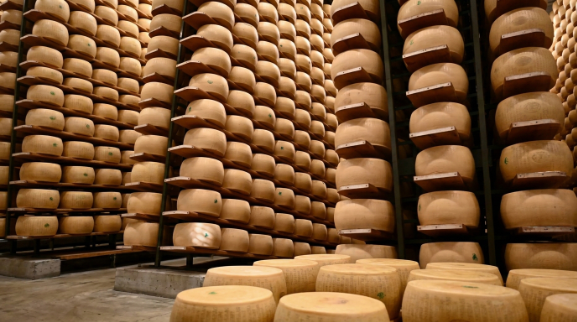
In the hills of Emilia-Romagna, Italy, some bank vaults contain something far more unusual than cash or valuable documents. Inside the warehouses of Credito Emiliano, locally known as Credem, hundreds of thousands of wheels of Parmigiano Reggiano are stored as collateral for loans to dairy farmers.
The unusual banking system dates back to 1953, when Credem began accepting young wheels of Parmigiano Reggiano as security for loans. The arrangement solves a major financial problem for local cheesemakers: the cheese takes between 12 and 36 months to fully mature, meaning producers have to wait years before their product reaches its final value.
Instead of forcing farmers to wait without income, the bank lends them money against the value of their cheese. Credem then stores the wheels in specialized, climate-controlled warehouses, where they can mature safely until they are ready to be sold.
The operation is enormous. Credem’s facilities in Reggio Emilia and Modena handle approximately 2.3 million wheels each year, with around 500,000 wheels reportedly stored at any given time. Together, the cheese in storage can be worth more than €300 million, or roughly $350 million.
The system is closely connected to the wider Parmigiano Reggiano industry, which is worth approximately €4 billion and includes around 300 certified dairies throughout the region. For generations of farmers, the cheese is not simply a food product—it is an important financial asset.
But the unusual system is now facing a new challenge: extreme heat.
Record temperatures across Europe are increasing the amount of energy required to keep the cheese warehouses at the precise temperature and humidity levels needed for proper aging. This year, the extreme heat has reportedly increased the warehouses’ daily energy consumption by around 30 percent.
To protect the valuable cheese inside, Credem has had to invest in upgrades to its cooling systems and boilers, increase insulation, and expand renewable energy generation. Without careful climate control, the conditions inside the warehouses could affect the quality of the cheese—and potentially the value of the collateral securing farmers’ loans.
The heat is also creating problems before the cheese even reaches the bank.
Extreme temperatures can affect dairy cows, causing them to lie down more frequently and eat less. As a result, milk production can decline by as much as 10 percent during periods of severe heat. For cheesemakers, less milk means less Parmigiano Reggiano can be produced.
That creates a chain reaction: hotter weather can reduce milk production, lower cheese output, increase the cost of storing and aging the cheese, and ultimately put additional pressure on the farmers who depend on the unusual banking system.
What began as a clever financial solution more than 70 years ago has therefore become an unexpected intersection of banking, agriculture, food production, and climate change.
In Emilia-Romagna, the value of a bank’s collateral is not measured only in euros. Sometimes, it is measured in wheels of cheese—and keeping those wheels safe is becoming increasingly difficult as the planet gets hotter.