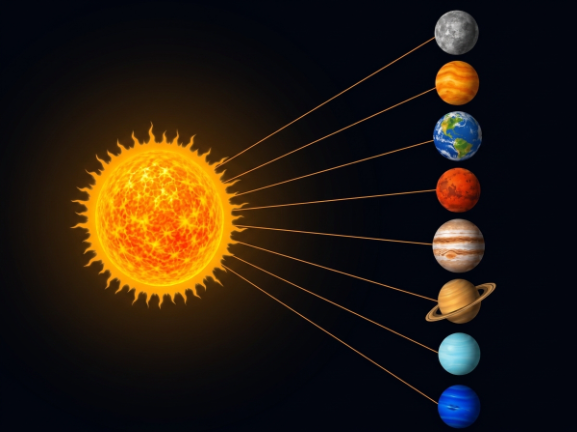
Light is the fastest thing known in the universe, traveling at an incredible speed of approximately 299,792 kilometers (186,282 miles) per second. Despite this extraordinary speed, the immense distances within our Solar System mean that sunlight still takes time to reach each planet.
Mercury, the closest planet to the Sun, receives sunlight in about 3.2 minutes. Venus follows at around 6 minutes, while sunlight reaches Earth in approximately 8.3 minutes. This means every time we look at the Sun, we are actually seeing it as it was more than eight minutes earlier, because that is how long its light takes to travel through space.
As the distance from the Sun increases, so does the time required for sunlight to arrive. Mars receives sunlight after about 12.7 minutes, Jupiter after roughly 43.3 minutes, and Saturn after approximately 79.3 minutes. These increasing travel times reflect the enormous distances separating each planet from the Sun.
The journey becomes even longer for the outer planets. Sunlight takes nearly 159.6 minutes to reach Uranus, while Neptune, the most distant major planet in the Solar System, receives sunlight after about 246 minutes—more than four hours after the light leaves the Sun. Because they are so far away, these distant planets receive far less sunlight and heat than the inner planets.
These travel times provide a simple way to understand the vast scale of our Solar System. Even light, which travels faster than anything else known in nature, cannot cross these enormous distances instantly. The farther a planet is from the Sun, the longer it takes for sunlight to reach it.
The concept extends far beyond our Solar System. When astronomers observe distant stars and galaxies, they are seeing light that has traveled for years, centuries, millions, or even billions of years before reaching Earth. As a result, telescopes allow scientists to observe celestial objects as they appeared in the past rather than as they exist at this exact moment.
From the eight-minute journey of sunlight to Earth to the four-hour trip to Neptune, the travel time of light offers a remarkable perspective on the immense size of our cosmic neighborhood and the vast distances that separate objects throughout the universe.