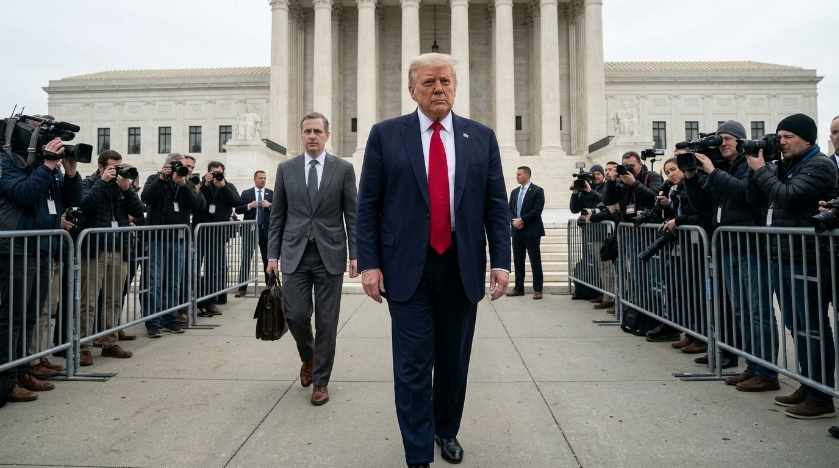
President Donald Trump’s administration is taking its fight over the proposed White House ballroom to the nation’s highest court after a federal appeals court ordered construction to stop.
The Justice Department filed an emergency request with the U.S. Supreme Court on Friday asking the justices to allow construction to continue while the administration challenges the lower court ruling. The project, estimated at about $400 million, has become one of the most significant legal disputes surrounding Trump’s White House renovations.
The move comes after the U.S. Court of Appeals for the District of Columbia Circuit ruled that the administration could not proceed with the project without congressional approval.
The appeals court’s decision temporarily halted above-ground construction on the planned 90,000-square-foot ballroom, which is being built on the site of the demolished East Wing. The court gave the administration time to seek Supreme Court intervention, with the ruling scheduled to take effect on August 21.
Now, the Trump administration is asking the Supreme Court to step in before that deadline arrives.
Solicitor General D. John Sauer argued that the lower court’s order goes too far and could interfere with what the administration describes as an integrated security and military complex at the White House.
“This case involves an extraordinary and unlawful injunction,” Sauer wrote in the administration’s filing, arguing that the project is “vitally required by national security.”
The administration’s argument represents a significant shift in how it is presenting the ballroom project.
The ballroom was initially promoted largely as a way to provide the White House with a larger space for state dinners and other major events. Trump has increasingly emphasized security features connected to the project, including underground facilities and protective infrastructure.
Administration officials now argue that stopping construction could interfere with security-related work.
The White House has also maintained that the project is being privately funded. Trump has repeatedly said that donors are paying for the ballroom rather than taxpayers directly.
But opponents of the project argue that the president cannot simply bypass Congress when making major changes to federal property.
The National Trust for Historic Preservation was among the groups that challenged the project after the historic East Wing was demolished. The organization has argued that the administration did not follow the required legal process before proceeding with the construction.
The dispute has already produced conflicting rulings.
A federal district judge previously allowed certain security-related construction to continue while blocking broader development. The D.C. Circuit later upheld the central restriction, concluding that Trump did not have unilateral authority to proceed with the ballroom without congressional authorization.
The appeals court’s decision has now pushed the dispute directly toward the Supreme Court.
Chief Justice John Roberts has asked the groups challenging the project to respond to the administration’s emergency request by Tuesday. That means the justices could soon have to decide whether construction should resume while the larger legal battle continues.
The administration says time is especially important because construction is already well underway.
According to court filings and administration statements, the project is roughly 65% complete after about 10 months of construction.
That has created another point of tension.
Trump’s lawyers argue that stopping the project now could cause significant disruption and delay, while opponents say the fact that construction has already progressed does not eliminate the requirement to obtain the necessary legal authorization.
The fight is therefore no longer simply about whether the White House should have a ballroom.
It has become a broader dispute over presidential authority, congressional power, historic federal property and the limits of executive control over the White House complex.
The Supreme Court’s eventual decision could determine whether Trump’s administration can proceed with the ballroom without additional approval from Congress.
For now, the immediate question is narrower but potentially decisive: Will the Supreme Court allow construction to continue while the legal battle plays out?
That answer could come before the current August 21 deadline, putting the nation’s highest court directly in the middle of Trump’s controversial White House construction project.