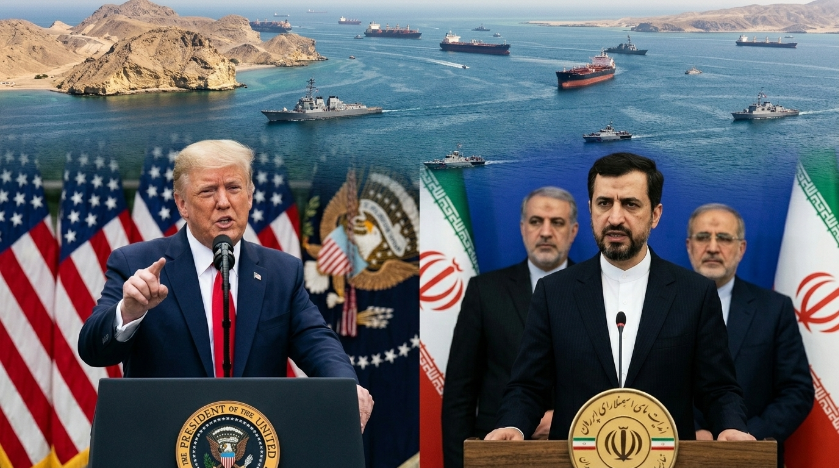
President Donald Trump has escalated his confrontation with Iran by saying he plans to declare the Strait of Hormuz a U.S. territory after what he described as the defeat of Iran.
Trump made the remark Friday during an appearance in Garden City, New York, saying the United States would soon take the extraordinary step involving one of the world’s most important maritime routes.
The statement immediately drew a response from Tehran, with Iranian officials rejecting any suggestion that the United States could take control of the waterway.
Iran’s Deputy Foreign Minister Kazem Gharibabadi said the Strait of Hormuz would remain under Iranian control and dismissed the idea that its status could be changed through American threats or declarations.
The confrontation comes as tensions over the strategic waterway continue to intensify.
The Strait of Hormuz connects the Persian Gulf with the Gulf of Oman and is a critical route for international energy shipments. Before the current conflict, more than 100 vessels could pass through the waterway on a typical day. Recent traffic, however, has fallen dramatically amid the fighting and competing claims of control.
Trump has repeatedly claimed that the United States now has effective control over the strait.
Earlier this week, he said the U.S. had “total control” of the waterway as American forces maintained pressure on Iran. Iran has strongly disputed that claim, with Iranian officials insisting that ships cannot pass without Iranian authorization.
The latest statement goes considerably further.
Trump said that after the United States finishes defeating Iran, he would declare the Strait of Hormuz a U.S. territory. He did not provide details explaining how such a change would be carried out or what legal authority would be used to establish American territorial control over the waterway.
That uncertainty is significant because the United States currently has no formal jurisdiction over the Strait of Hormuz.
The waterway has long been subject to international maritime rules, while Iran and Oman border the strait. Iran has maintained a strong claim over control of the waterway and has repeatedly used its strategic position there as leverage during regional confrontations.
The dispute is also having consequences far beyond the Middle East.
Shipping through the strait has fallen sharply, while tensions have contributed to higher energy prices. Reuters reported that the waterway once carried roughly 20% of global oil supplies, making prolonged disruption a major concern for international energy markets.
Trump has acknowledged that Americans are facing higher gasoline prices because of the conflict but has argued that preventing Iran from obtaining a nuclear weapon is worth the economic cost.
Iran, meanwhile, has shown little indication that it intends to accept Trump’s demands.
Iranian officials have linked the reopening of the waterway to broader concessions from Washington, while negotiations aimed at ending the conflict remain stalled.
The disagreement has therefore developed into a much larger confrontation over who controls one of the world’s most strategically important waterways.
For Trump, the proposed territorial declaration represents another escalation in his pressure campaign against Tehran.
For Iran, accepting such a move would amount to surrendering a strategic position that its government considers fundamental to its national security.
And with shipping still severely disrupted, the consequences could extend to global oil markets, gasoline prices and international trade.
For now, the biggest question is whether Trump’s declaration was intended as a concrete policy objective, a negotiating threat or something else—and how far Washington and Tehran are prepared to go over control of the Strait of Hormuz.