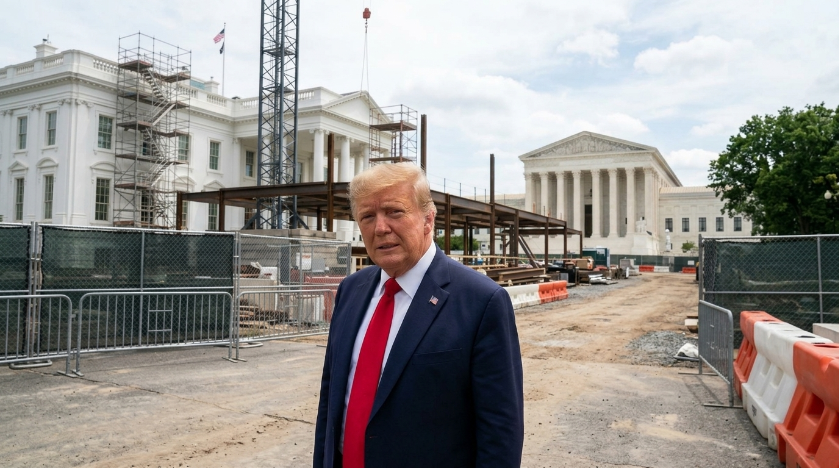
President Donald Trump’s administration has taken its controversial White House ballroom project to the Supreme Court after a federal appeals court ordered construction to stop unless Congress gives the project its approval.
The administration filed an emergency request asking the justices to allow construction to continue while the legal fight moves forward.
The dispute centers on Trump’s planned $400 million, 90,000-square-foot ballroom, which is being built where the White House’s former East Wing once stood.
The legal battle escalated after the U.S. Court of Appeals for the D.C. Circuit ruled 2-1 that the administration could not proceed with the project without congressional authorization.
The appeals court temporarily paused its ruling, giving the Trump administration time to seek intervention from the Supreme Court. The order is currently scheduled to take effect on August 21.
Trump’s administration is arguing that the project involves far more than a traditional event space.
Solicitor General D. John Sauer described the project as an integrated security and military complex and argued that stopping construction could create serious national-security concerns.
The administration has pointed to security features planned for the project, including reinforced structures and protective systems, while arguing that the White House needs a more secure facility for major events and visiting foreign leaders.
The government’s Supreme Court filing also referenced a previously undisclosed security incident involving Trump while he was traveling in Turkey.
According to the filing, a threatened missile attack against Air Force One on July 8 was among the security concerns cited by the administration in arguing that the project should be allowed to continue.
That revelation adds another layer to the already heated dispute.
Trump has repeatedly defended the ballroom and argued that the project is privately funded. The administration maintains that construction is already substantially underway and that stopping the work would cause significant disruption.
Opponents of the project have taken a very different position.
The National Trust for Historic Preservation, which challenged the construction, argues that the administration cannot bypass the legal and congressional processes required for such a major alteration to the White House complex.
The organization has urged the Supreme Court to reject the administration’s request to continue construction during the appeal.
The dispute has therefore become much bigger than a fight over a ballroom.
At its core is a question about how much authority a president has to make major changes to the White House complex without congressional approval.
For Trump, the case also represents another major confrontation with the federal courts.
His administration has increasingly turned to the Supreme Court when lower courts have blocked or restricted major initiatives, making the justices an increasingly important battleground for Trump’s second-term agenda.
For now, construction remains at the center of the dispute, with the Supreme Court facing pressure to decide whether Trump’s administration can keep the project moving while the broader legal challenge continues.
And with the August 21 deadline approaching, the next move from the nation’s highest court could determine whether Trump’s controversial White House project keeps rising — or faces another major setback.