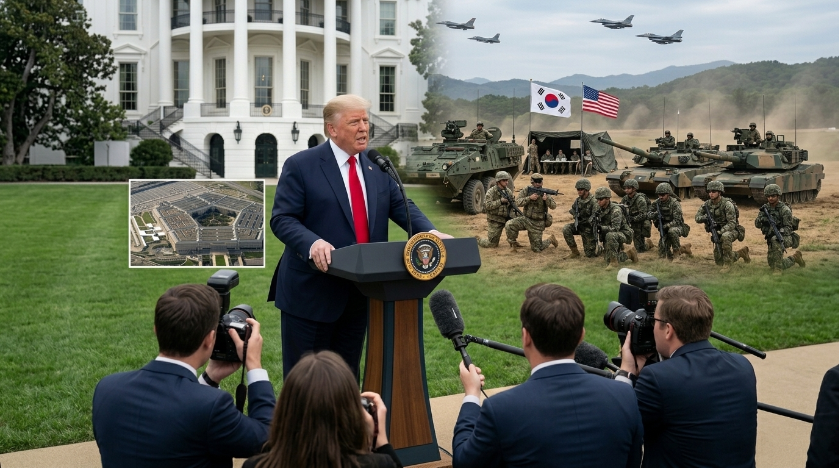
President Donald Trump has ordered the Pentagon to substantially reduce joint military exercises with South Korea, making an unexpected move involving one of America’s most important military alliances in Asia.
The decision came just as the annual Ulchi Freedom Shield exercises were scheduled to begin, putting renewed attention on Trump’s long-standing criticism of the cost and purpose of large-scale military drills with Seoul.
Trump announced the move Sunday, saying he was unhappy that the United States had agreed to participate in the exercises.
The president pointed to both the cost of the drills and his relationship with North Korean leader Kim Jong Un.
“Based on my very good relationship with Kim Jong Un,” Trump said, he was not happy that the United States had agreed to participate in the exercises.
Trump also criticized South Korea over its position on U.S. actions against Iran.
According to Reuters, Trump said he had asked South Korean President Lee Jae Myung whether Seoul wanted to participate in U.S. efforts involving Iran, but said South Korea declined.
Trump argued that the exercises were expensive and sent what he described as an inappropriate and hostile signal toward North Korea.
The timing of the announcement was particularly notable.
The Ulchi Freedom Shield exercises began Monday as scheduled and are expected to continue through August 27. Approximately 18,000 South Korean military personnel are participating. The drills are designed to prepare the allies for potential threats on the Korean Peninsula, including drones, cyberattacks and GPS disruptions.
South Korea’s military confirmed that the exercises would proceed as scheduled, despite Trump’s order.
The South Korean government said it was reviewing Trump’s comments and expressed hope that improved relations between Trump and Kim could eventually lead to meaningful dialogue between Washington and Pyongyang.
The decision is not entirely unprecedented.
Trump has previously criticized U.S.-South Korean military exercises as expensive and provocative. During his first presidency, he temporarily suspended major exercises following his 2018 summit with Kim Jong Un.
But the strategic environment has changed considerably since then.
North Korea has continued developing its nuclear and missile capabilities, while its military cooperation with Russia has also increased. North Korea recently launched ballistic missiles ahead of the latest U.S.-South Korean exercises.
That has raised questions about whether reducing the exercises could affect military readiness and deterrence in the region.
Some analysts believe Trump’s decision could be part of an effort to create another diplomatic opening with Kim Jong Un, while others have warned that reducing military exercises could create concerns among U.S. allies about America’s long-term commitment to the region.
For now, the exercises are continuing, but Trump’s order has opened a new debate in Washington and Seoul over the future of America’s military presence in East Asia.
The bigger question is whether Trump’s latest move will lead to renewed negotiations with North Korea — or create new concerns among America’s allies about the U.S. commitment to regional security.