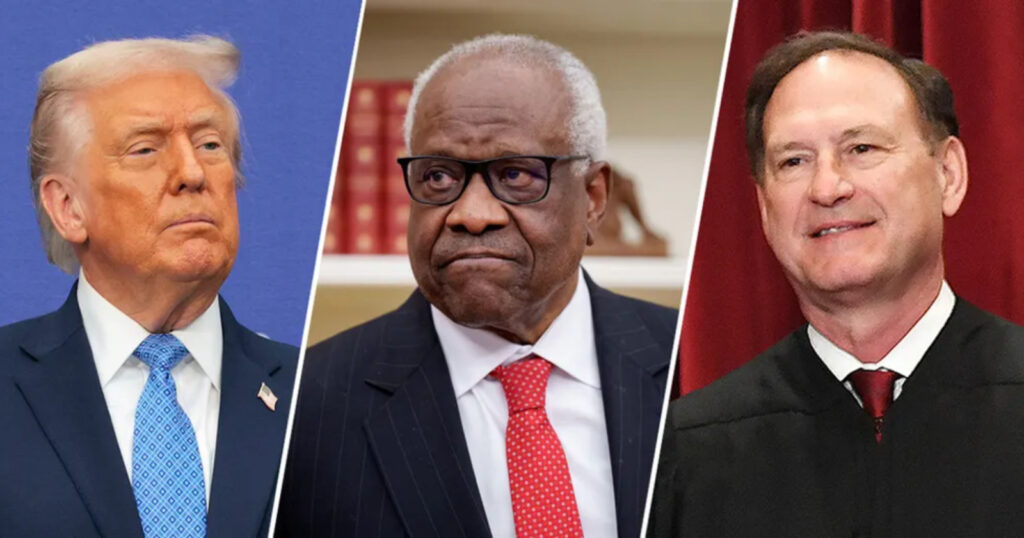
President Donald Trump’s long-running legal battle against CNN remains alive after the U.S. Supreme Court granted him additional time to ask the nation’s highest court to review his defamation lawsuit.
The extension keeps alive Trump’s effort to revive a case that lower federal courts previously dismissed and gives his legal team more time to prepare its appeal.
Supreme Court Justice Clarence Thomas granted Trump’s second request for additional time, extending the deadline to file a petition for a writ of certiorari until Aug. 14.
Trump is asking the Supreme Court to review decisions by lower federal courts that dismissed his $475 million defamation lawsuit against CNN.
Justice Thomas had previously granted Trump’s first extension in early June, moving the original deadline to July 15.
In his second request, filed July 1, Trump’s attorneys argued that additional time would “greatly serve the interest of justice and reduce any interruption” to his responsibilities as president.
The lawsuit stems from CNN’s coverage of Trump’s repeated claims that the 2020 presidential election was fraudulent.
Trump alleged the network defamed him by repeatedly referring to those claims as the “Big Lie.”
According to the lawsuit, Trump argued that CNN’s use of that phrase intentionally associated him with Adolf Hitler and Nazi propagandist Joseph Goebbels, who historically used the term in reference to propaganda techniques.
Trump’s attorneys contended that those comparisons harmed his reputation by leading viewers to associate him with some of history’s most notorious figures.
CNN has disputed those claims throughout the litigation.
The case was originally filed in federal court in Florida.
In July 2023, U.S. District Judge Raag Singhal dismissed the lawsuit, concluding that CNN’s statements were protected expressions of opinion rather than actionable defamation under applicable First Amendment standards.
Trump appealed that ruling to the U.S. Court of Appeals for the Eleventh Circuit.
In November 2025, a three-judge panel upheld the dismissal.
Trump then asked the full Eleventh Circuit to rehear the case, but the court declined to do so in March, exhausting his options in the lower federal courts.
His remaining avenue is to ask the Supreme Court to hear the appeal.
The Supreme Court receives thousands of petitions each year but agrees to hear only a small percentage of cases.
Granting an extension to file a petition does not indicate whether the Court is likely to ultimately take up the case.
Instead, it simply gives Trump’s legal team additional time to prepare and submit its arguments requesting Supreme Court review.
If the petition is filed by the new Aug. 14 deadline, the justices will later decide whether to grant certiorari and hear the case.
If the Court declines review, the lower courts’ dismissal will remain in place.
Trump is represented in the matter by attorneys Alejandro Brito of Brito PLLC and Richard C. Klugh of Klugh Wilson LLC.
Representatives for both Trump and CNN did not immediately comment following the latest extension.
For now, the Supreme Court has not weighed in on the merits of Trump’s claims.
The only action taken is extending the filing deadline, allowing the president additional time to ask the justices to review whether his lawsuit against CNN should be revived after being dismissed by the lower federal courts, Law360 reported.
The Supreme Court handed the Trump administration another legal victory this week by throwing out a federal appeals court ruling that had revived a dispute over public speaking restrictions for immigration judges.
In an unsigned order, the justices reversed a decision of the Fourth Circuit Court of Appeals.
They reinstated a lower-court ruling dismissing a lawsuit filed by the National Association of Immigration Judges.
The case centered on a Justice Department policy requiring immigration judges to obtain approval before participating in certain public speaking engagements deemed “official” in nature.
The policy requires immigration judges to obtain approval before participating in “official” speaking engagements, including presentations at immigration conferences or pro bono legal training events.