Most mammals take their first breath on their own, but for a newborn orca, survival during its first moments often depends on the support of its family.
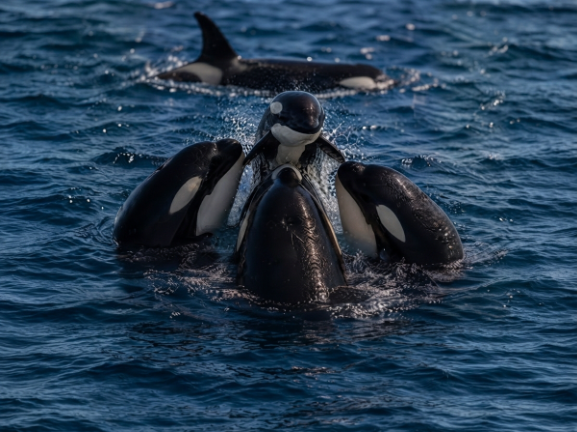
On November 2, 2024, researchers observing orcas off the coast of northern Norway witnessed an exceptionally rare event—a wild orca giving birth. Using drone footage, they documented the newborn calf surrounded by members of its pod as they gently helped guide it toward the ocean’s surface during the first moments of its life.
Unlike land mammals, orcas are born underwater and must reach the surface quickly to breathe through their blowhole. During those critical first minutes, a newborn calf is often too weak to swim or stay afloat without assistance. To improve the calf’s chances of survival, its mother is frequently joined by other experienced females and pod members, who work together to lift, support, and protect the newborn until it gains enough strength to swim independently.
Scientists have observed similar cooperative behavior in other orca populations, including the endangered Southern Resident killer whales. These observations demonstrate the species’ highly social nature, where cooperation, communication, and strong family bonds play an essential role in raising young and supporting the survival of the pod.
Wild orca births are rarely documented because they typically occur far from shore and often under the cover of darkness. As a result, opportunities to observe and record the first moments of a calf’s life are extremely uncommon. The sighting in northern Norway is considered one of the most detailed observations of a wild orca birth ever recorded, providing researchers with valuable insights into the species’ early life behavior.
After successfully reaching the surface and taking its first breaths, the calf gradually became more confident in the water. Once it was able to swim alongside the adults, the pod continued its journey together through the Norwegian sea, demonstrating the close social bonds that characterize orca families.
The remarkable event offers a rare glimpse into one of nature’s least-seen moments and highlights the importance of cooperation within orca pods. For these highly intelligent marine mammals, the first moments of life are not faced alone but are supported by the collective care and experience of the family group.