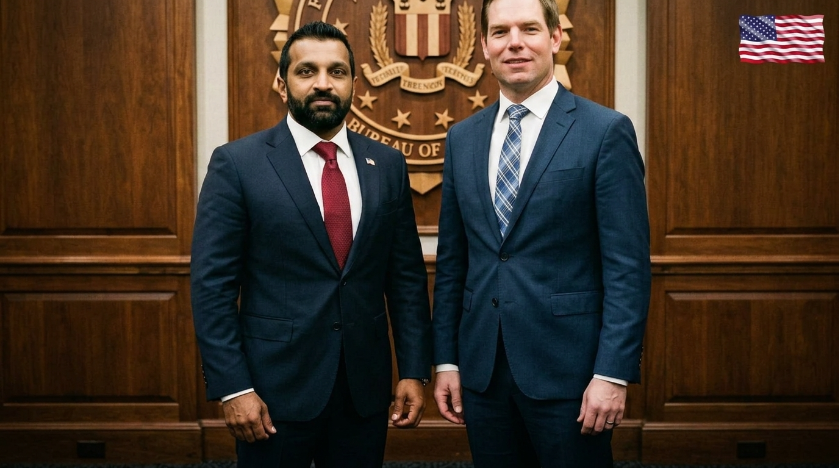
Newly declassified FBI records have renewed public attention on a difficult national-security question: How aggressively should the federal government investigate foreign intelligence operations that target American politicians and other public officials?
The question has gained renewed relevance following the release of records concerning former Rep. Eric Swalwell and Christine Fang, a Chinese national whom U.S. officials investigated over suspected connections to China’s intelligence services. The documents provide additional details about the FBI’s counterintelligence investigation and Swalwell’s interactions with Fang.
But the broader issue extends well beyond one politician or one investigation.
The FBI is the United States’ lead counterintelligence agency and says its responsibility includes detecting and lawfully countering foreign intelligence activities that threaten U.S. national interests. Its counterintelligence work covers espionage, foreign influence operations and other hostile intelligence activities.
That raises an important question for Americans: Should the FBI take an aggressive approach whenever credible foreign intelligence threats involve elected officials, or should investigators operate under more restrictive standards because of the political consequences?
Why Elected Officials Can Be Attractive Targets
Foreign intelligence services do not necessarily need access to classified documents to gain something valuable from American political institutions.
Politicians can have access to policymakers, government officials, campaign networks, donors, sensitive information and influential relationships. Foreign governments may also seek to cultivate relationships with people who could eventually occupy important positions.
The FBI says foreign intelligence threats can include espionage, foreign influence operations and transnational repression. The bureau currently identifies China, Russia and Iran among the countries posing significant foreign-intelligence challenges, while also monitoring threats from several other governments.
The Swalwell-Fang case illustrates why relationships involving politicians can attract counterintelligence scrutiny.
According to newly released FBI records, Swalwell acknowledged to investigators that he had a physical relationship with Fang. The FBI had already been examining Fang’s activities and connections to political figures. The records provide additional insight into the bureau’s investigation, although they do not by themselves establish that Swalwell knowingly participated in espionage.
That distinction is critical.
The Case for Aggressive Investigations
Supporters of a tougher approach argue that waiting until foreign intelligence activity becomes obvious espionage could be too late.
Counterintelligence investigations are often designed to identify threats before classified information is stolen or a foreign influence network becomes deeply embedded.
The FBI itself describes its mission as protecting U.S. secrets and critical assets while countering foreign spies and hostile intelligence activities. More than 100 agencies participate in counterintelligence task forces around the country, reflecting the government’s effort to coordinate responses to foreign threats.
From this perspective, elected officials should not receive special protection from legitimate counterintelligence scrutiny simply because they hold public office.
If credible evidence suggests that a foreign intelligence service is attempting to cultivate, influence, recruit or exploit an American official, supporters argue that investigators should have the authority and resources to determine what is happening.
They also argue that foreign intelligence operations can evolve over time. What begins as a seemingly ordinary political relationship could potentially become something more serious.
The Case Against Overly Aggressive Investigations
The strongest argument against an unchecked approach is not that foreign intelligence threats are harmless. It is that investigative power can itself be abused.
An investigation does not prove wrongdoing. A politician communicating with a foreign national, accepting a donation from someone with international connections or appearing in the same social circles as a foreign individual does not automatically constitute espionage or illegal foreign influence.
That means investigators must distinguish between a legitimate counterintelligence lead and ordinary political or personal activity.
This concern becomes particularly important when investigations involve elected officials. Intelligence investigations can have enormous political consequences even when prosecutors ultimately find insufficient evidence for criminal charges.
The history of U.S. intelligence investigations also demonstrates why oversight matters. Critics have long warned that national-security authorities can become politically controversial when intelligence collection intersects with elections and partisan politics.
For that reason, “aggressive” should not mean unlimited.
It should mean thorough, evidence-based and appropriately resourced.
The Kash Patel Question
The debate is particularly relevant under FBI Director Kash Patel, whose leadership has brought renewed political attention to the bureau’s handling of counterintelligence matters.
The FBI’s current counterintelligence mission remains broader than investigations involving elected officials. The bureau says it is responsible for responding to foreign intelligence threats across government, business, technology and other sectors.
Recent reporting has also described Patel’s efforts to expand law-enforcement cooperation with countries including China and Russia while maintaining counterintelligence safeguards. That approach has generated questions inside and outside the bureau about how the United States should cooperate with foreign governments that are simultaneously viewed as strategic competitors or intelligence threats.
That tension highlights the complexity of modern counterintelligence.
The United States must protect itself from foreign intelligence operations while still maintaining diplomatic relationships and legitimate international cooperation.
What the Evidence Shows
There is little question that foreign intelligence services actively target American institutions.
The FBI says hostile governments employ espionage, foreign influence operations, cyber activity, transnational repression and efforts to obtain sensitive technology and information.
The question is therefore not whether foreign intelligence threats exist.
The harder question is where investigators should draw the line between a credible national-security threat and conduct that merely appears suspicious.
That line matters because counterintelligence investigations can involve surveillance, confidential sources, classified information and significant government resources.
An effective system needs both capabilities: investigators must be able to move quickly when credible evidence indicates a foreign operation, while oversight mechanisms must prevent political considerations from determining who gets investigated.
What Would a Balanced Approach Look Like?
A rigorous approach could involve several principles.
First, credible foreign-intelligence threats should be investigated regardless of political party.
Second, investigators should distinguish intelligence leads from established evidence and should not publicly treat an investigation as proof of wrongdoing.
Third, investigations involving elected officials should receive appropriate legal and institutional oversight.
Finally, the same standards should apply whether the target is a Democrat, Republican, independent official or politically unaffiliated government employee.
That balance may be more important than simply asking whether investigations should be “aggressive.”
The real question is whether the FBI can be aggressive against genuine foreign intelligence threats while remaining disciplined about evidence, legality and political neutrality.
What Happens Next?
The release of the new FBI records is likely to keep the debate over foreign influence and political figures alive.
The documents provide additional information about a past counterintelligence investigation, but they do not establish that every allegation involving a public official represents espionage. At the same time, the case demonstrates why relationships between foreign operatives and people with access to American political institutions can attract serious national-security scrutiny.
The broader challenge is likely to become even more complicated as foreign governments use traditional intelligence operations alongside cyberattacks, social-media influence campaigns, financial networks and increasingly sophisticated technology.
For the FBI, the task is therefore two-sided: identify and disrupt genuine foreign intelligence threats before they cause harm, while ensuring that counterintelligence powers are not transformed into tools of political retaliation.
Conclusion
Foreign intelligence operations targeting American institutions represent a genuine national-security concern, and elected officials should not be automatically shielded from legitimate investigation.
But aggressive enforcement must have boundaries.
The strongest counterintelligence system is not one that investigates people simply because they are politically controversial or connected to foreigners. It is one that responds forcefully when credible evidence indicates a foreign intelligence threat, applies the same standards to everyone and maintains sufficient oversight to protect constitutional rights.
So where should the line be drawn: should the FBI aggressively investigate every credible foreign intelligence threat involving elected officials, or should additional safeguards limit how those investigations are conducted?