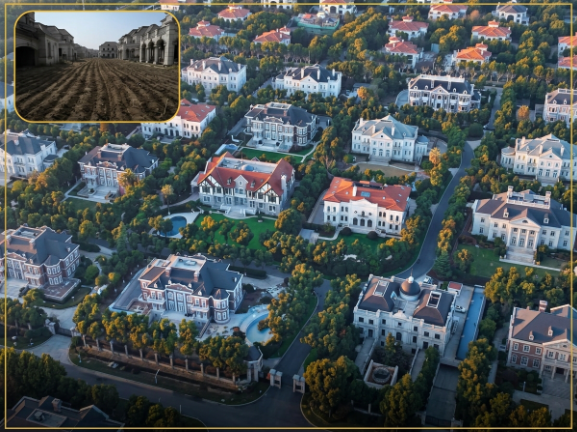
On the outskirts of Shenyang, in northeastern China, there is a development called the State Guest Mansions. From a distance it looks like something out of a European architectural catalogue, 260 grand villas with marble interiors, crystal chandeliers, spiral staircases, and ornate gardens, designed as a luxury retreat for China’s elite and high-ranking government visitors.
Construction began in 2010. It halted two years later, in 2012, and never resumed.
Walk through the grounds today and the contrast is staggering. The marble floors are still there. The chandeliers still hang from the ceilings. The spiral staircases lead to empty rooms. But the driveways that were designed for Ferraris and luxury cars are now dirt paths where local farmers grow vegetables. The manicured gardens where China’s elite were supposed to entertain have been taken over by cattle, which wander freely between the empty mansions.
The project cost an estimated $238 million. Not a single resident ever moved in.
The most commonly cited reason is corruption. When President Xi Jinping came to power in 2012, he launched a sweeping crackdown on displays of wealth and government excess. Funding for the project was cut off almost immediately, and the development was quietly abandoned. A local farmer who spoke to AFP put it simply: “Frankly, it was because of official corruption. They cut off the funding and cracked down on uncontrolled developments, so it was left half-finished.”
The State Guest Mansions are not an isolated case. China currently has an estimated 65 to 80 million vacant homes, including entire cities, replica European villages, and financial districts modeled on Manhattan, all built and left empty. Experts have called it the largest misallocation of capital in human history.
A country that built mansions for the elite ended up giving them to cows.