October 7, 2022 — Friday, 8:10 AM
Everglades National Park, Florida
The Everglades had been on my travel list for years.
I wanted four quiet days away from phones, traffic, and busy schedules. I had always loved photographing wildlife, and few places in America offered the same combination of birds, mangrove forests, and endless waterways.
Planning this trip became part of the adventure.
Weeks before leaving, I studied maps of the backcountry campsites, checked tide charts, reviewed weather forecasts, and packed carefully.
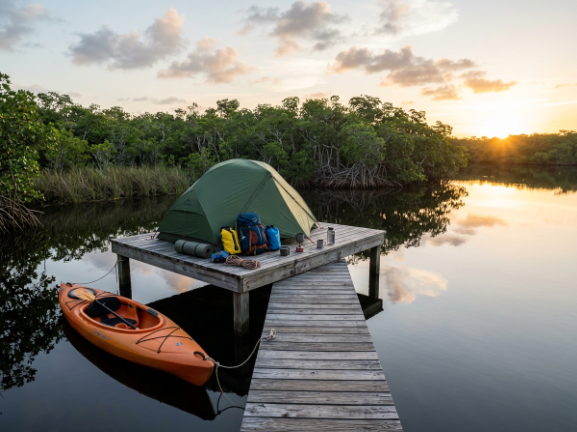
My kayak carried everything I needed.
A lightweight tent.
Food for four days.
Several gallons of drinking water.
A filtration system.
Extra clothes sealed inside dry bags.
A first-aid kit.
Emergency blankets.
Rain gear.
A satellite communicator.
Spare batteries.
I even packed extra rope in case strong winds picked up.
The weather forecast looked encouraging.
Scattered afternoon showers.
Light winds.
Typical October conditions.
Nothing suggested I would soon experience one of the most frightening wilderness trips of my life.
The paddle into the backcountry was beautiful.
Mangrove tunnels twisted through calm water.
Herons hunted quietly along muddy banks.
Pelicans glided overhead.
Occasionally I spotted alligators drifting almost motionless beneath the surface before disappearing into the marsh.
The farther I paddled, the quieter everything became.
By mid-afternoon, I reached my reserved backcountry campsite.
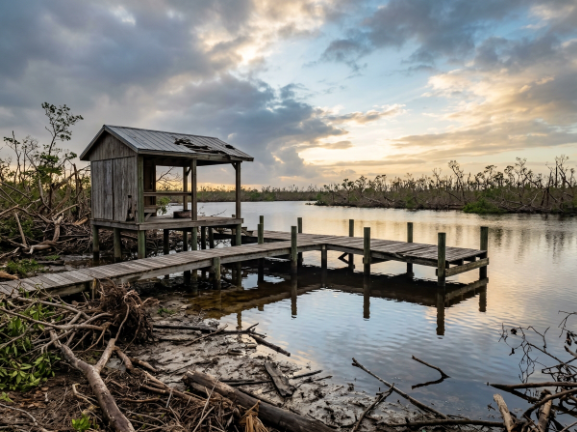
It consisted of a raised wooden platform built above the wetlands with a small dock beside it.
I unloaded my gear, pitched my tent, organized my supplies, and spent the evening photographing birds as the setting sun painted the sky orange and purple.
The air felt peaceful.
Warm.
Perfect.
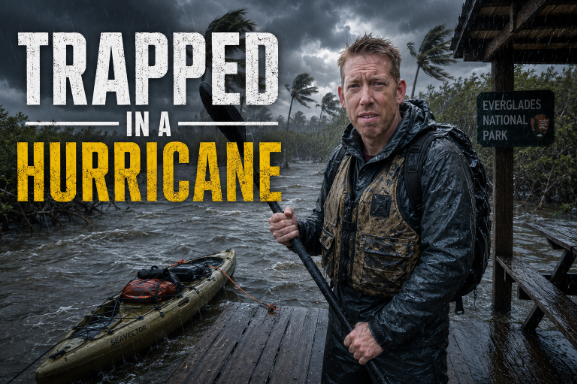
If someone had told me that less than twenty-four hours later I would be trapped by a hurricane, I never would have believed it.
Before Everything Went Wrong
The next morning began almost exactly the same.
Warm air drifted across the wetlands while a light breeze barely disturbed the water. I made coffee and watched the sunrise from the edge of the platform, listening to birds calling somewhere beyond the mangroves.
Everything felt calm.
After breakfast, I packed my camera into a waterproof bag and paddled deeper into the maze of narrow channels.
The Everglades seemed endless.
Around every corner waited another incredible view.
Roseate spoonbills searched the shallows for food.
Great blue herons stood perfectly still beside fallen logs.
Schools of fish scattered beneath my kayak whenever I drifted too close.
I spent hours taking photographs and simply enjoying the silence.
Around lunchtime I noticed the first change.
The wind strengthened.
Clouds appeared faster than they had earlier that morning.
The birds that had filled the marsh suddenly became much quieter.
At first, I assumed another afternoon rainstorm was approaching.
That wasn’t unusual.
When I checked my satellite communicator, a weather bulletin appeared.
A tropical storm over the Gulf had strengthened unexpectedly.
Forecasters warned it could become a hurricane sooner than expected.
I stared at the message for several moments.
The safest decision seemed obvious.
Leave now.
I packed my camera, secured every piece of equipment inside dry bags, and immediately started paddling back toward the visitor area.
Within twenty minutes, I realized I wasn’t going anywhere.
The water had transformed.
Strong headwinds pushed against every stroke.
Small waves slapped the side of my kayak.
Large branches floated through the narrow channels.
Progress became painfully slow.
I kept pushing for another half hour before accepting reality.
Trying to continue would only increase the risk of capsizing.
Reluctantly, I turned around.
Returning to camp felt like admitting defeat.
But it was the only safe decision left.
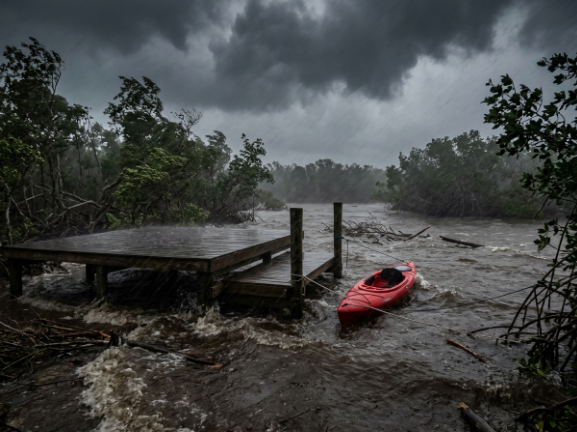
As I tied my kayak back to the dock, the first distant rumble of thunder echoed across the Everglades.
The adventure I had planned was over.
Something very different had begun.
The Moment Survival Begins
The rain arrived just before sunset.
Not the gentle showers I had expected.
This rain fell sideways.
Wind drove sheets of water through the mangrove trees with surprising force, rattling every loose object around the campsite.
I tightened every guyline on my tent.
Moved my dry bags toward the center of the platform.
Checked every knot securing my kayak.
Then I waited.
By nightfall, visibility had dropped to almost nothing.
The weather alerts became increasingly urgent.
The tropical storm had officially reached hurricane strength.
Emergency messages advised everyone in the backcountry to shelter in place until conditions improved.
Rescue operations had already stopped.
That message stayed in my mind.
Nobody was coming.
Not tonight.
The wind continued building throughout the evening.
Every hour sounded louder than the one before.
Branches snapped somewhere beyond the campsite.
Rain hammered the wooden roof above my tent without slowing.
Shortly after midnight, curiosity got the better of me.
I pulled on my rain jacket, grabbed my headlamp, and stepped outside.
The beam of light reflected off water that hadn’t been there earlier.
Storm surge had begun flooding the marsh around the campsite.
Small waves rolled beneath the wooden platform.
Floating branches drifted past the dock.
The kayak strained against its ropes as powerful gusts pushed it from side to side.
I stood there watching the water slowly climb the steps leading to the platform.
Each wave reached a little farther than the one before.
That was the exact moment everything changed.
I wasn’t camping anymore.
I wasn’t waiting for the weather to improve.
For the next four days, survival became my only plan.
The Fight to Survive
Morning arrived without sunlight.
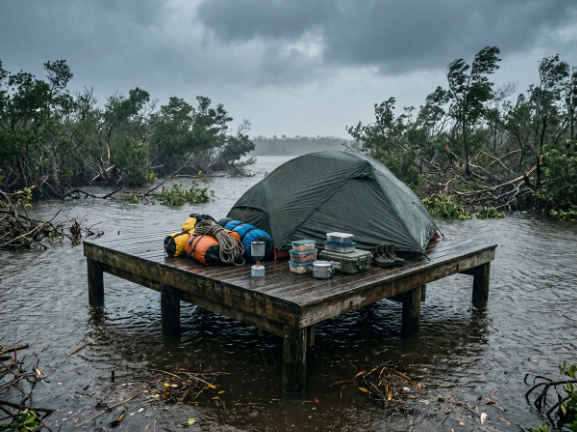
The sky remained a solid sheet of dark gray, and the wind showed no sign of weakening. Rain continued to hammer the platform roof, creating a constant rhythm that never seemed to end. I unzipped my tent just enough to look outside.
The Everglades had completely changed overnight.
The calm water I had paddled through the day before was gone. In its place were muddy waves pushing through the mangroves, carrying broken branches, leaves, and floating debris. Water now surrounded every side of the platform, swallowing the small patches of marsh grass that had been visible only hours earlier.
I checked my satellite communicator.
After several minutes, one short message finally downloaded.
“Remain sheltered. Rescue operations suspended until weather improves.”
Reading those words made the situation feel real.
Nobody could reach me.
If something went wrong, I was completely on my own.
I stopped thinking about leaving.
Instead, I focused on protecting what I still had.
I moved every dry bag to the highest corner of the platform and secured them with extra rope. My food containers stayed sealed unless I absolutely needed them. Every time I opened a bag, I made sure it was closed again immediately to keep the rain out.
The hurricane forced me into a routine.
Wake up.
Check the water level.
Inspect the tent.
Secure the kayak.
Eat a small meal.
Rest.
Repeat.
The routine gave me something to control when everything else felt unpredictable.
Food quickly became one of my biggest concerns.
I had packed enough for four comfortable days, not knowing I might have to stretch those supplies if the storm lasted longer than expected. Breakfast became a single energy bar instead of two. Lunch was a handful of trail mix. Dinner was a packet of instant soup heated on my backpacking stove while I sat inside the tent listening to the storm outside.
I wasn’t hungry enough to panic.
But I was careful.
Every meal became a decision instead of a habit.
Water wasn’t difficult to find.
Rain filled every container I owned within hours.
Even so, I filtered everything before drinking it. There was no reason to take unnecessary risks while I was already dealing with so much uncertainty.
The hardest challenge wasn’t physical.
It was mental.
Time almost stopped.
Without sunshine, without people, and without anywhere to go, every hour blended into the next. I caught myself checking my watch repeatedly, convinced that much more time had passed than it actually had.
Outside, the world had become nothing but wind and water.
Inside my tent, I kept reminding myself to stay patient.
The storm would end eventually.
I just didn’t know when.
That uncertainty became heavier than my backpack had ever been.
Night brought another round of powerful wind.
I lay awake listening as something large crashed somewhere beyond the mangroves. Every loud sound made me wonder if another tree had fallen across the platform or if my kayak had broken free.
Several times I stepped outside with my headlamp to check.
Each time I found the kayak still tied securely where I had left it.
Seeing it there gave me hope.
As long as I still had the kayak, I still had a way home.
The Hardest Moment
The third morning began strangely.
The wind faded.
The rain slowed to a light drizzle.
For the first time in two days, I heard birds again.
I cautiously stepped outside.
Blue sky appeared overhead, and sunlight reflected off the floodwater surrounding the campsite. For a brief moment, everything looked peaceful.
I had unknowingly entered the eye of the hurricane.
The silence felt almost unreal.
I used those precious minutes to tighten ropes, reorganize supplies, and stretch my stiff legs. I even allowed myself to believe the worst might finally be over.
Then I looked south.
A dark wall of clouds stretched across the horizon.
It was moving toward me faster than I expected.
Within minutes, the wind returned with even greater force than before.
The second half of the hurricane arrived like a freight train.
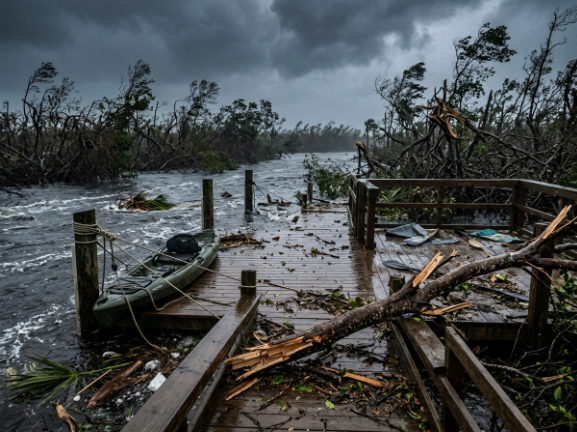
One violent gust snapped a thick mangrove branch that crashed across the edge of the platform with a deafening crack. The entire structure shook beneath my feet.
At the same moment, I heard another sound.
A sharp snap.
One of the ropes holding my kayak had broken.
The kayak slammed repeatedly against the dock, pushed by powerful waves.
If it drifted away, my safest way out would disappear with it.
I didn’t have time to think.
I grabbed another rope and crawled toward the dock, keeping as low as possible while the wind tried to knock me sideways.
Rain stung my face.
The platform trembled beneath every gust.
My hands slipped several times as I fought to thread the rope through the kayak’s handle.
Finally, I pulled the knot tight.
Seconds later, another wave slammed against the dock hard enough to spray water over my shoulders.
I scrambled back toward the shelter of the platform, breathing harder than I had all week.
Once inside, I sat quietly for several minutes.
My hands wouldn’t stop shaking.
Not because of the cold.
Because I finally understood how close I had come to losing the only reliable way home.
That afternoon became the lowest point of the trip.
The rain returned.
The sky darkened once more.
I stared across the flooded marsh, wondering how many more hours—or days—the storm might continue.
For the first time, I admitted to myself that I was frightened.
Not because I believed I couldn’t survive.
Because I had no idea when the waiting would finally end.
So I made one simple promise.
I wouldn’t think about tomorrow.
I would only think about the next hour.
That single thought carried me through the rest of the storm.
The Ending
I woke before sunrise on the fourth morning.
The silence immediately felt different.
There was still wind, but it no longer roared.
The rain had stopped.
When I stepped outside, I saw patches of blue sky breaking through the clouds.
The hurricane had finally moved away.
The Everglades looked almost unrecognizable.
Trees leaned at impossible angles.
Entire sections of mangrove forest had been torn apart.
Floating debris covered the channels where I had paddled only days earlier.
The water remained high, but it was beginning to settle.
I checked my satellite communicator one more time.
A new message appeared.
“Weather improving. Rescue teams entering backcountry. Stay at your campsite.”
I read it twice before allowing myself to believe it.
Late that afternoon, I heard the faint sound of an engine somewhere in the distance.
At first I wasn’t sure if I imagined it.
The sound grew louder.
A National Park Service rescue boat slowly emerged through the damaged mangrove channel, carefully navigating around fallen trees and floating debris.
I walked to the edge of the platform and waved both arms.
The ranger saw me almost immediately.
The feeling that followed is difficult to describe.
Relief mixed with gratitude.
Exhaustion mixed with excitement.
Four days of constant stress seemed to disappear in a single moment.
As we slowly traveled back toward the visitor center, I looked behind me one last time.
The small wooden platform where I had spent four unforgettable days was still standing.
Barely.
Back at the ranger station, I learned that the hurricane had caused extensive flooding throughout Everglades National Park. Several backcountry campsites had been damaged, waterways remained blocked by fallen mangroves, and some areas would stay closed for weeks while crews cleared debris and inspected the damage.
Driving home later that day, I replayed every decision I had made.
Packing carefully.
Turning back instead of forcing my way through dangerous water.
Protecting my supplies.
Staying patient.
None of those choices felt extraordinary at the time.
Together, they made all the difference.
I still love exploring remote places.
I still believe there is nothing quite like waking up surrounded by nature.
But that experience taught me something I will never forget.
The wilderness doesn’t care how experienced I am.
It doesn’t care how carefully I planned.
Nature can change in minutes, and the smartest decision is often the one that requires the most humility.
Whenever I hear heavy rain now, I remember standing on that flooded platform in the middle of the Everglades, listening to the wind and watching the water slowly rise.
I survived because I respected the storm instead of trying to outrun it.
That lesson will stay with me far longer than any photograph I brought home.