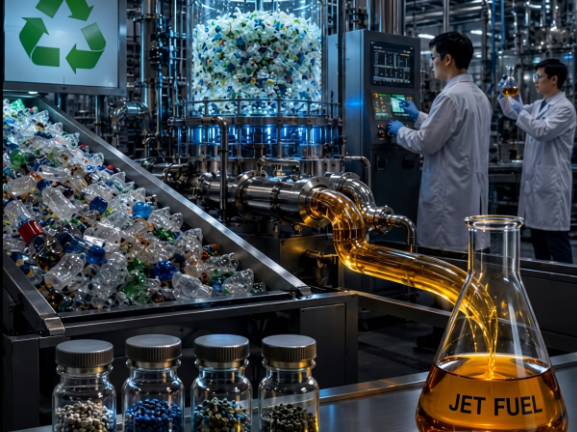
Scientists in China have developed an experimental technology that could transform plastic waste into jet fuel, offering a potential solution to two major global challenges: reducing plastic pollution and producing more sustainable aviation fuel.
The research was carried out by a team from the Shanghai Advanced Research Institute of the Chinese Academy of Sciences and Fudan University. Using a specially designed nickel-cobalt catalyst, the researchers successfully converted common plastic waste—including plastic bottles, bags, and other widely used materials—into hydrocarbons similar to those found in conventional aviation fuel.
Plastic waste has become one of the world’s fastest-growing environmental problems. More than 460 million tonnes of plastic are produced globally each year, with large quantities ending up in landfills, rivers, and oceans, where they can remain for decades before breaking down. Finding new ways to recycle plastic into valuable products has become a major focus of scientific research in recent years.
According to the research team, laboratory testing showed that the new process achieved liquid fuel yields of more than 82% while operating at lower temperatures than many existing plastic recycling methods. Lower operating temperatures could improve energy efficiency and potentially reduce production costs if the technology is successfully developed for industrial use.
Although the results are promising, the technology is still in the experimental stage and has not yet been tested on a commercial scale. Researchers must demonstrate that the process can be expanded efficiently, remain economically viable, and consistently produce fuel that meets aviation industry standards before it could be adopted by airlines.
If those challenges can be overcome, the technology could help reduce the amount of plastic waste entering the environment while providing an alternative source of aviation fuel. Instead of being discarded, everyday plastic products could one day become a valuable raw material for producing cleaner fuels, supporting both waste reduction and more sustainable air transportation.
While further research and large-scale testing are still required, the study represents another step toward developing innovative recycling technologies that give plastic waste a second life and reduce its environmental impact.