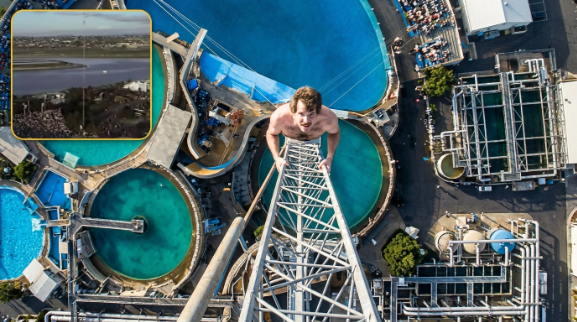
In 1983, SeaWorld San Diego did something that would never get approved today. They built a steel tower 172 feet above a pool, broadcast it live on ABC’s Wide World of Sports, and invited six professional divers to jump off it in front of thousands of spectators.
The year before, they had done a trial run at 170 feet. Five divers attempted it. Every single one sustained an injury, because hitting water at over 75 miles per hour is roughly equivalent to hitting concrete. The pool didn’t help matters either. It was salt water, chilled to 52 degrees Fahrenheit.
SeaWorld’s response was to raise the platform two feet higher and do it again.
The 1983 event produced some genuinely extraordinary dives. Dana Kunze, a 22-year-old world champion who already held more records than anyone else in the sport, delivered what most observers called the dive of the day, a near-perfect performance that essentially ended the competition before it was over.
One diver remained. Pat Picard knew he had no realistic chance of beating Kunze’s score, but he wanted to at least match the height record. He dove. He knocked himself out cold on impact.
What happened next revealed a fairly significant oversight in SeaWorld’s event planning. There were no lifeguards on duty. The people who jumped in to pull Pat Picard from the water were competitors from the women’s diving event who had been watching from the poolside.
He survived. Five of the six divers successfully completed the 172-foot dive that day, and all five were credited with the world record. It has never been broken in over 40 years.
Since then, people have jumped from greater heights, but none without sustaining serious injuries, and none while completing the required somersault. Those are the rules of the sport, and so far, nobody has cleared them from higher than 172 feet.
SeaWorld Built a 172-Foot Diving Tower — Then Divers Jumped From It on Live TV