Every year, China shuts down for Golden Week, a national holiday that sends hundreds of millions of people onto the roads at the same time. In 2025, the holiday coincided with the Mid-Autumn Festival, creating a rare eight-day break and triggering one of the largest single travel surges in human history. Over 888 million domestic trips were made across the country in a single week.
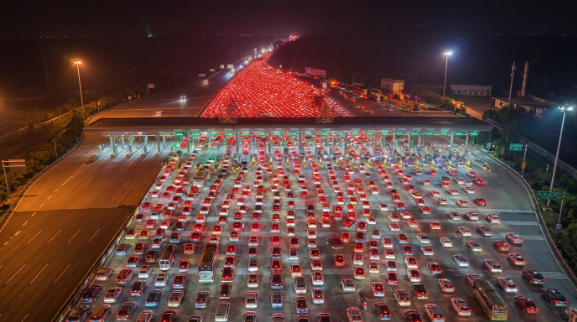
A significant number of those trips passed through the Wuzhuang Toll Station in Anhui province, China’s largest toll plaza and the junction of two of the country’s busiest expressways.
Wuzhuang has 36 lanes. The idea is simple: fan traffic out across dozens of booths so cars can clear scanners quickly, then merge them back together on the other side. On a normal day it works fine. On the final day of Golden Week, when every family in eastern China is trying to get home at the same time, it does not.
On October 9, 2025, over 120,000 vehicles passed through Wuzhuang in a single day. From above, drone footage showed nothing but red taillights stretching across all 36 lanes as far as the camera could see. The jam lasted nearly 24 hours. Drivers sat in their cars through the night, barely moving, as the 36-lane plaza funneled every vehicle into four lanes on the other side.
Authorities urged drivers to take alternate routes. Subway and bus services in the area were extended to try to absorb some of the volume. Neither made much of a dent.
This wasn’t even China’s worst traffic jam on record. In 2010, a traffic jam on the Beijing-Tibet Expressway stretched 62 miles and lasted 12 days, with some drivers stuck for five days straight, buying water from roadside vendors at ten times the normal price.
China’s 36-Lane Toll Plaza Turned Into a 24-Hour Traffic Nightmare