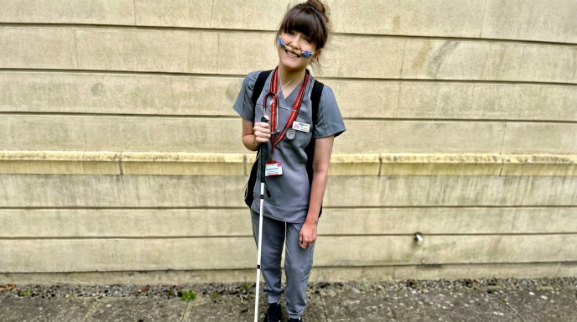
Alexandra Adams was born deaf and blind, and for most of her life she never saw that as a limitation.
“I never saw myself as any different,” the 32-year-old told This Morning the day after she received her medical degree, making her the UK’s first-ever DeafBlind doctor. “That all changed” when she decided to go to medical school. “Then suddenly people were saying, ‘Oh, you can’t do that because you’re DeafBlind.'”
She decided she wanted to become a doctor as a teenager, after spending 17 months in hospital following surgery complications. One doctor changed everything. She noticed Adams was frightened and asked three simple words: “Are you okay?” Adams said no. The doctor drew the curtains, showed her a scar across her own abdomen, and said: “I know how you feel.”
“It’s that empathy that I could use in the future to help other people,” Adams said. “And that’s what I get to do now.”
Getting there took over a decade. Medical school came with discrimination at every turn, COVID hospitalization, and two and a half years away from her studies. She has an immune disorder called Mast Cell Activation Syndrome requiring her to use oxygen. None of it stopped her.
The question people ask most is how she actually practices medicine. Adams uses a Bluetooth stethoscope that connects directly to her hearing aids, radio aids, vibrating pagers, and special bleeps. For inserting needles and IVs, she relies on touch. “As someone with sight loss, my sense of touch and feel is naturally heightened,” she said. Medical students are actually encouraged to look away when inserting needles because the best ones are done by feel.
Her young patients have no idea. “They honestly think I’ve got super hearing,” she said.
“My disabilities haven’t been the obstacle in my medical degree,” Adams added. “It’s been the perceptions of other people. I think discrimination has been a big hurdle.”
She is now considering geriatric or palliative care. “It’s all about safety,” she said. “I have to be realistic along the way.”
Born DeafBlind, She Became the UK’s First DeafBlind Doctor