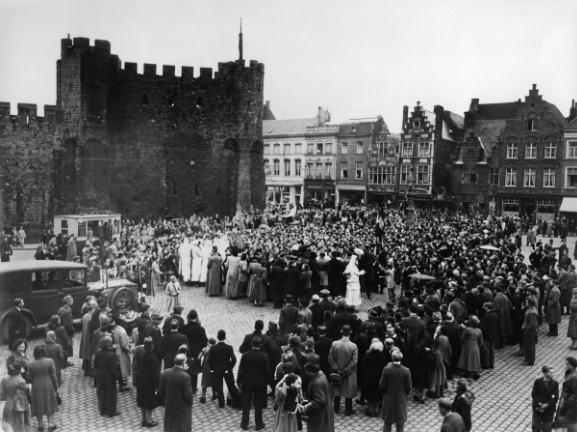
In Ghent, Belgium, there is a medieval castle called the Gravensteen, built in 1180 and one of the most intact fortresses in Western Europe. It has survived Viking raids, the industrial revolution, and two World Wars. The one thing it could not survive was a one-franc increase in the price of beer.
On the morning of November 16, 1949, 138 students from the University of Ghent hatched a plan over drinks and decided to do something about the new Belgian beer tax, which had raised the cost of a beer from 3 francs to 4. They stormed the Gravensteen.
The operation was executed with surprising efficiency. The students scaled the castle walls, located the lone guard on duty, and stuffed him in a closet. They lowered the portcullis, barricaded the gate with a cart full of rotting fruit, and raised protest banners from the battlements demanding the price of beer be returned to 3 francs.
They also had a second demand. They wanted the police to stop wearing white helmets, on the grounds that the helmets looked too similar to postmen’s uniforms. Exactly why this mattered to them has never been fully explained.
When police arrived, the students pelted them with rotten fruit and smoke bombs from the ramparts. The crowd that gathered in the streets below was not rooting for the police. Public sympathy was overwhelmingly with the students, and when firefighters eventually scaled the walls with long ladders and removed the occupiers after several hours, the outcry was immediate. Not a single one of the 138 students was ever prosecuted.
Their protest was ultimately unsuccessful. The beer price stayed at 4 francs.
But every November 16, Ghent students pour into the streets surrounding the Gravensteen to drink beer, sing “The Battle of Gravensteen,” and commemorate the day 138 people decided that a medieval castle was a proportionate response to a one-franc beer tax.